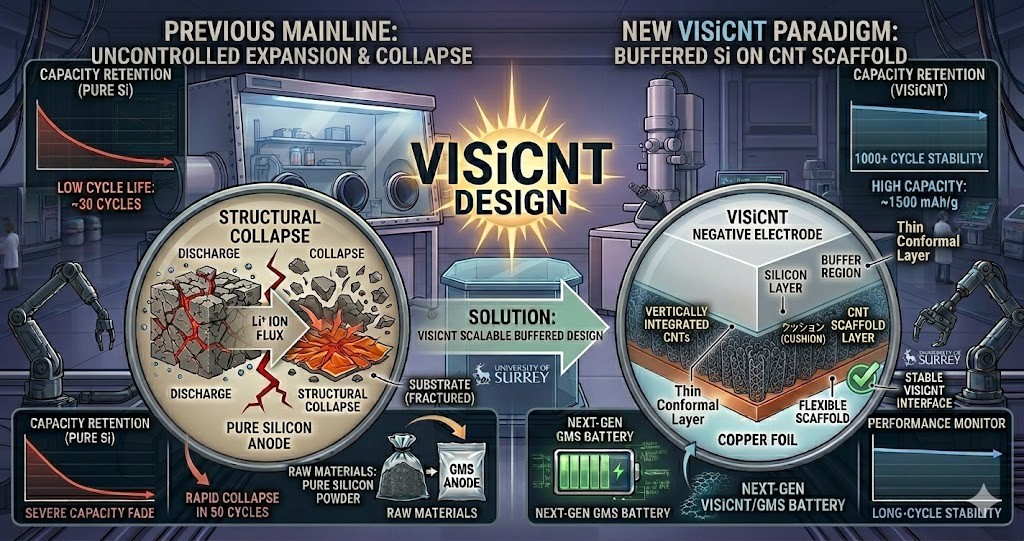
電気自動車(EV)の航続距離延長やスマートフォンの長時間駆動を実現するため、バッテリーの「負極(アノード)」材料の刷新が急務となっています。長年主流だったグラファイト(黒鉛)に代わり、理想の材料とされるのが「シリコン」です。
しかし、シリコンには充放電時に激しく膨張・収縮し、構造が崩壊するという致命的な弱点がありました。英国サリー大学の研究チームが発表した「VISiCNT」設計は、カーボンナノチューブを「柔軟な足場」として活用することで、この課題を克服し、理論限界に近い超高容量を実現する画期的な技術です。
- サリー大学の開発:「VISiCNT」構造の革新性
- 関連情報:シリコン負極市場と次世代電池の背景
- 負極材料の性能比較データ
- Over 3,500 mAh/g Demonstrated: Carbon Nanotubes Solve Silicon Anode “Expansion Problem”
サリー大学の開発:「VISiCNT」構造の革新性
1. 技術の概要
- 名称: VISiCNT(Vertically Integrated Silicon-Carbon Nanotube / 垂直統合型シリコン・カーボンナノチューブ)
- 構造: 銅箔の上にカーボンナノチューブを高密度に垂直成長させ、その表面を薄いシリコン層でコーティングしたハイブリッド構造。
- 特徴: ナノチューブの隙間がシリコンの膨張を吸収する「クッション」となり、構造の劣化を防ぎながら高い導電性を維持します。
2. 驚異的なパフォーマンス
- 比容量: 3,500 mAh/g 以上を実証。
- 比較: 従来のグラファイト負極(約370 mAh/g)に対し、約10倍のエネルギー蓄電能力を持ちます。
- 耐久性: シリコン特有の機械的劣化を抑え、充放電を繰り返しても高い容量を維持できることが確認されました。
3. 商用化へのアドバンテージ
- 既存インフラとの互換性: 銅箔に直接ナノチューブを成長させる手法をとっており、現在のロールツーロール(巻き取り式)製造ラインに導入しやすい設計です。
- 高速製造: 直接成長プロセスを高速化することで、低コストでのスケールアップが期待されています。
関連情報:シリコン負極市場と次世代電池の背景
今回の研究を理解するための補足情報を追加します。
1. なぜ「シリコン」なのか?
シリコンはリチウム原子を大量に取り込むことができるため、理論上のエネルギー密度はグラファイトの約10倍に達します。テスラなどの主要なEVメーカーも、グラファイトに少量のシリコンを混ぜる手法を既に導入していますが、シリコン100%に近い負極の実現には、今回の研究のようなナノ構造制御が不可欠です。
2. 固体電池との棲み分け
現在、究極の次世代電池として「全固体電池」の開発が進んでいますが、量産コストや製造技術に課題が残っています。VISiCNTのような「既存のリチウムイオン電池の枠組みを改良する技術」は、既存の工場設備を流用できるため、全固体電池が普及するまでの間の、あるいはそれと並行する有力な解決策と見なされています。
3. カーボンナノチューブ(CNT)の役割
CNTは導電性に優れるだけでなく、非常に強靭で柔軟な素材です。バッテリー内部での「電子の通り道」と「シリコンの保持枠」の両方の役割を果たすため、シリコン負極の実用化において最も有力なパートナー素材の一つとされています。
負極材料の性能比較データ
| 項目 | グラファイト(従来型) | シリコン負極(VISiCNT) |
| 主な材料 | 黒鉛 | シリコン + カーボンナノチューブ |
| 理論比容量 | 372 mAh/g | 約 4,200 mAh/g(材料単体) |
| 実証値 | 約 350 – 370 mAh/g | 3,500 mAh/g 以上 |
| 主な課題 | 容量の限界 | 体積膨張(約300%以上)による崩壊 |
| VISiCNTの解決策 | - | CNTの足場による膨張の吸収 |
ラヴィ・シルバ教授(サリー大学)のコメント
「この技術はEVだけでなく、電力網の蓄電やマイクロエレクトロニクスにも大きな可能性を秘めています。既存の生産ラインに最小限の影響で統合できる点が最大の強みです。」
出典:https://www.bestmag.co.uk/silicon-nanotube-anode-design-promises-boost-in-lithium-ion-performance/
Over 3,500 mAh/g Demonstrated: Carbon Nanotubes Solve Silicon Anode “Expansion Problem”
To extend the range of electric vehicles (EVs) and the battery life of smartphones, there is an urgent need to revolutionize battery anode materials. Silicon is considered the ideal replacement for graphite, which has been the industry standard for decades.
However, silicon has a fatal weakness: it expands and contracts violently during charging and discharging, leading to structural collapse. The “VISiCNT” design, announced by a research team at the University of Surrey (UK), overcomes this challenge by using carbon nanotubes as a “flexible scaffold,” achieving ultra-high capacity near theoretical limits.
Innovation of the University of Surrey’s “VISiCNT” Structure
1. Technology Overview
- Name: VISiCNT (Vertically Integrated Silicon-Carbon Nanotube)
- Structure: A hybrid structure where carbon nanotubes are grown vertically at high density on copper foil and coated with a thin silicon layer.
- Features: The gaps between the nanotubes act as a “cushion” that absorbs silicon expansion, maintaining high conductivity while preventing structural degradation.
2. Extraordinary Performance
- Specific Capacity: Demonstrated over 3,500 mAh/g.
- Comparison: Approximately 10 times the energy storage capacity of conventional graphite anodes (approx. 370 mAh/g).
- Durability: Confirmed to suppress mechanical degradation unique to silicon, maintaining high capacity even after repeated charge-discharge cycles.
3. Advantages for Commercialization
- Compatibility with Infrastructure: The method of growing nanotubes directly on copper foil makes it easy to integrate into current roll-to-roll (winding) production lines.
- High-Speed Manufacturing: Speeding up the direct-growth process is expected to allow for low-cost scaling.
Related Information: Silicon Anode Market and Next-Gen Battery Background
The following information provides context for this research:
1. Why Silicon?
Silicon can absorb a large number of lithium atoms, giving it a theoretical energy density roughly 10 times that of graphite. Major EV makers like Tesla have already begun mixing small amounts of silicon into graphite, but nanostructure control like this research is essential to realize anodes made nearly 100% of silicon.
2. Differentiation from Solid-State Batteries
While “all-solid-state batteries” are being developed as the ultimate next-gen battery, they face challenges in mass-production costs and manufacturing technology. Technologies like VISiCNT, which improve the existing lithium-ion framework, are seen as viable solutions because they can utilize existing factory equipment.
3. The Role of Carbon Nanotubes (CNTs)
CNTs are not only excellent conductors but are also extremely strong and flexible. They serve as both a “pathway for electrons” and a “holding frame for silicon,” making them one of the most promising partner materials for commercializing silicon anodes.
Anode Material Performance Comparison
| Item | Graphite (Conventional) | Silicon Anode (VISiCNT) |
| Main Material | Graphite | Silicon + Carbon Nanotubes |
| Theoretical Capacity | 372 mAh/g | Approx. 4,200 mAh/g (material only) |
| Demonstrated Value | Approx. 350 – 370 mAh/g | Over 3,500 mAh/g |
| Primary Challenge | Capacity limits | Collapse due to volume expansion (300%+) |
| VISiCNT Solution | N/A | Expansion absorption by CNT scaffold |
Comment from Professor Ravi Silva (University of Surrey)
“This technology has huge potential not only for EVs but also for grid energy storage and small batteries used in microelectronics. Its greatest strength is that it can be integrated into existing production lines with minimal disruption.”


コメント