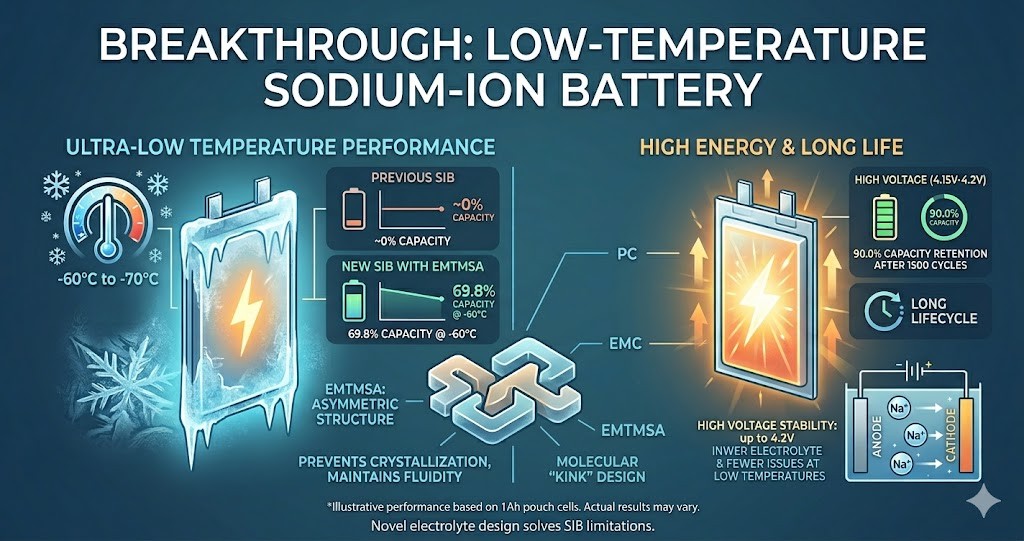
この研究は、ナトリウムイオン電池(SIB)の課題である「エネルギー密度の低さ(電圧の限界)」と「低温環境での性能低下」を、独自の分子設計による電解液組成で解決したものです。
1. 開発された電解液の具体的な組成
研究チームは、メイン溶媒である新開発の「EMTMSA」に、既存の溶媒を特定の比率で混合することで、粘度・導電率・化学的安定性のベストバランスを実現しました。
- 電解質塩: 1 M NaFSI (1 mol/L Sodium bis(fluorosulfonyl)imide)
- 混合溶媒 (体積比 6:1:3):
- EMTMSA (60 vol%): 主溶媒。非対称構造により融点をマイナス86度まで低下させた新分子。
- PC (10 vol%): プロピレンカーボネート。高い誘電率を持ち、Na塩の解離を助ける。
- EMC (30 vol%): エチルメチルカーボネート。低粘度でイオンの移動度を高める。
2. 核心技術:非対称分子「EMTMSA」の役割
EMTMSA(N-ethyl-N-methyl-trifluoromethanesulfonamide)は、窒素原子にメチル基とエチル基を非対称に配置しています。
- 結晶化の阻止: 幾何学的な「ねじれ(Kink)」が、冷却時の分子の規則正しい整列を妨げます。
- 液状維持: このため、マイナス60度以下の極低温でも凝固せず、流動性を保ちます。
- 高電圧耐性: スルホンアミド骨格が4.2V以上の高電圧下でも酸化分解されにくい強固な特性を持っています。
3. 主な実証成果(1Ah級パウチセル)
実用サイズに近い大容量セルにおいて、以下の驚異的な性能を達成しました。
| 動作条件 | 容量維持率 / 性能 | 備考 |
| マイナス60度 | 69.8% (対常温比) | 従来液はほぼ0% |
| マイナス70度 | 42.3% (対常温比) | 極寒地でも動作可能 |
| 4.15V 高電圧 | 90.0% (1500サイクル後) | 驚異的な長寿命 |
| 4.20V 高電圧 | 81.6% (1000サイクル後) | SIBとして極めて高い安定性 |
4. 関連情報と背景解説
なぜ「NaFSI」と「EMTMSA」の組み合わせなのか?
この組成では、ナトリウムイオン(Na+)の周りにアニオン(FSI-)が密集する「接触イオン対(CIP)」や「凝集体(AGG)」が多く形成されます。これにより、充放電時に電極表面で効率よくアニオンが分解され、イオン導電性が高く、かつ強固な保護膜(SEI/CEI)が形成されます。これが、高電圧での劣化と低温での抵抗増大を同時に防ぐ鍵となっています。
産業的インパクト
今回の組成は、難燃性も備えており、熱暴走の開始温度を40度以上(163度から206度へ)引き上げています。安価なナトリウムを用いながら、リチウムイオン電池並みの電圧で、しかも極寒から猛暑まで動くこの電池は、寒冷地の電力貯蔵システムや安価な電気自動車(EV)の実現を加速させます。
出典:https://www.nature.com/articles/s41467-026-70592-z
Ideal for Arctic Environments and Winter EVs: New Solvent with -86 degrees C Melting Point Accelerates Commercialization of Sodium-Ion Batteries
This research addresses the critical challenges of sodium-ion batteries (SIBs)—namely “low energy density (voltage limitations)” and “performance degradation in cold environments”—through a unique electrolyte composition based on innovative molecular design.
1. Specific Composition of the Developed Electrolyte
The research team achieved an optimal balance of viscosity, conductivity, and chemical stability by mixing the newly developed primary solvent, EMTMSA, with existing solvents in a precise ratio:
- Electrolyte Salt: 1 M NaFSI (1 mol/L Sodium bis(fluorosulfonyl)imide)
- Mixed Solvent (6:1:3 Volume Ratio):
- EMTMSA (60 vol%): The primary solvent. A novel molecule whose asymmetric structure lowers the melting point to -86 degrees C.
- PC (10 vol%): Propylene carbonate. Features a high dielectric constant to assist in the dissociation of sodium salts.
- EMC (30 vol%): Ethyl methyl carbonate. Lowers viscosity to enhance ion mobility.
2. Core Technology: The Role of the Asymmetric Molecule “EMTMSA”
EMTMSA (N-ethyl-N-methyl-trifluoromethanesulfonamide) features an asymmetric arrangement of methyl and ethyl groups on the nitrogen atom.
- Prevention of Crystallization: A geometric “kink” prevents the orderly alignment of molecules during cooling.
- Maintaining Fluidity: This allows the electrolyte to remain liquid without solidifying even at ultra-low temperatures below -60 degrees C.
- High-Voltage Resistance: The sulfonamide backbone possesses robust characteristics that resist oxidative decomposition even under high voltages of 4.2V or more.
3. Key Demonstration Results (1-Ah-Level Pouch Cells)
In large-capacity cells close to practical size, the following remarkable performance was achieved:
| Operating Condition | Capacity Retention / Performance | Remarks |
| -60 degrees C | 69.8% (Relative to RT) | Conventional liquids are nearly 0% |
| -70 degrees C | 42.3% (Relative to RT) | Operable in extreme cold regions |
| 4.15V High Voltage | 90.0% (After 1500 cycles) | Extraordinary long cycle life |
| 4.20V High Voltage | 81.6% (After 1000 cycles) | Extremely high stability for a SIB |
4. Context and Background
Why the Combination of “NaFSI” and “EMTMSA”?
This composition promotes the formation of “Contact Ion Pairs (CIPs)” and “Aggregates (AGGs)” where anions (FSI-) cluster around sodium ions (Na+). During charging and discharging, this leads to efficient anion decomposition at the electrode surface, forming a highly ionic-conductive and robust protective film (SEI/CEI). This is the key to simultaneously preventing high-voltage degradation and low-temperature resistance increase.
Industrial Impact
The composition also features flame-retardant properties, raising the self-generated heat initiation temperature by over 40 degrees C (from 163 degrees C to 206 degrees C). By utilizing low-cost sodium while operating at voltages comparable to lithium-ion batteries—and functioning across a range from extreme cold to intense heat—this battery will accelerate the realization of energy storage systems in cold regions and affordable electric vehicles (EVs).

コメント