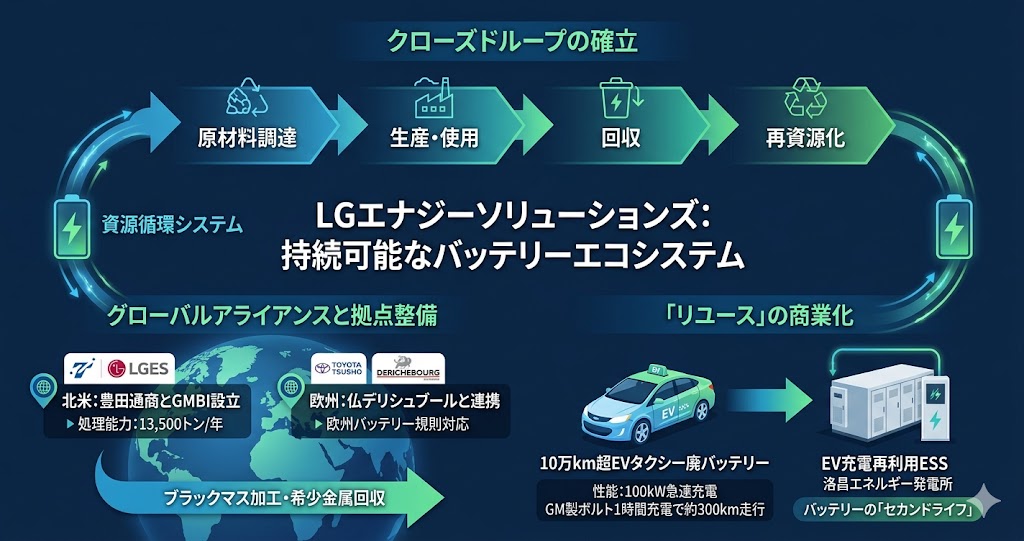
バッテリー世界大手のLGエナジーソリューションズ(以下、LGES)は、使用済みバッテリーのリサイクルおよび再利用(リユース)事業を次世代の主要な成長ドライバーと位置づけ、持続可能な資源循環システムの構築を加速させている。原材料の調達から生産、使用、回収、そして再資源化までを一気通貫で管理する「クローズドループ(閉ループ)」の確立により、激化するグローバルな規制対応と資源確保の両立を目指す構えだ。
- ## 1. 日米欧で進む戦略的アライアンスと拠点整備
- ## 2. 「リユース(再利用)」の商業化:EVバッテリーを蓄電池へ
- ## 3. 背景:なぜ「バッテリーリサイクル」が急務なのか?(関連情報)
- ## 4. 今後の展望:サステナビリティを競争力の核に
- 1. Strategic Alliances and Infrastructure Development Across Japan, the US, and Europe
- 2. Commercializing “Reuse”: Repurposing EV Batteries for Energy Storage
- 3. Background: Why Battery Recycling is Now Urgent (Context)
- 4. Future Outlook: Sustainability as the Core of Competitiveness
## 1. 日米欧で進む戦略的アライアンスと拠点整備
LGESは、主要市場である北米と欧州において、現地パートナーとの合弁事業を通じてリサイクル網を網羅的に広げている。
- 北米:豊田通商との連携2025年6月、トヨタグループの豊田通商と共同で、ノースカロライナ州に合弁会社「グリーンメタルズ・バッテリー・イノベーションズ(GMBI)」を設立。
- 処理能力: 年間最大13,500トン(EV約4万台分相当)。
- 役割: 使用済みバッテリーの安全な破砕および「ブラックマス(希少金属を含む混合粉末)」への加工。ここからリチウム、コバルト、ニッケルを回収し、新電池の材料として再投入する。
- 欧州:仏デリシュブールとの提携フランスの金属リサイクル大手、デリシュブール社との合弁により、欧州域内での回収・処理体制を強化。これは、厳格化する欧州の「バッテリー規則」への直接的な対応策となる。
## 2. 「リユース(再利用)」の商業化:EVバッテリーを蓄電池へ
リサイクル(分解・抽出)の前段階として、寿命を迎えたEVバッテリーをそのまま活用する「リユース」事業も具体化している。
- EV充電再利用ESS:現在、洛昌(オクチャン)エネルギー発電所で稼働中のこのシステムは、走行距離10万kmを超えた電気タクシーの廃バッテリーを再利用している。
- 性能: 100kWの急速充電に対応。GM製EV「ボルト」に対し、1時間の充電で約300km走行分(航続距離の大部分)の電力を供給可能。
- 意義: バッテリーの「セカンドライフ」を創出することで、製品寿命を延ばし、環境負荷とコストを同時に低減する。
## 3. 背景:なぜ「バッテリーリサイクル」が急務なのか?(関連情報)
LGESがリサイクルに注力する背景には、単なる環境保護を超えた「経済的・地政学的合理性」がある。
| 要因 | 内容と影響 |
| 法的規制 (EU) | 2030年代に向け、新電池へのリサイクル材料の使用(リチウム6%、ニッケル6%等)が義務化される。 |
| 米国IRA法 | 北米でリサイクルされた重要鉱物を使用することが税額控除の条件となり、現地での資源回収が不可欠に。 |
| 資源安全保障 | リチウムやコバルトの海外依存度を下げ、域内の「都市鉱山」から安定的に原料を確保する戦略。 |
| コスト削減 | 原鉱石からの精錬に比べ、廃バッテリーからの抽出はエネルギー消費を抑えられ、長期的なコスト競争力に直結する。 |
## 4. 今後の展望:サステナビリティを競争力の核に
LGESの担当者は、「循環型バッテリー資源システムを構築することで、持続可能な未来への移行をリードし、顧客価値を向上させる」と強調している。
2026年現在、バッテリー価格の下落と競争激化が進む中で、原料を自給自足できる体制を持つことは、自動車メーカー(OEM)に対する強力な交渉力となる。LGESは今後、AIを活用したバッテリー診断技術を導入し、リユースかリサイクルかの判定を最適化する「バッテリー・アズ・ア・サービス(BaaS)」モデルの展開も視野に入れている。
出典:https://www.koreaherald.com/article/10700808
Turning “Waste into Wealth”: LG Energy Solution’s Next Move in the Battery Recycling Market
LG Energy Solution (LGES), a global leader in the battery industry, is positioning the recycling and reuse of spent batteries as its next major growth driver. The company is accelerating the construction of a sustainable resource circulation system. By establishing a “closed-loop” ecosystem—managing everything from raw material procurement and production to usage, collection, and re-processing—LGES aims to balance compliance with tightening global regulations and the securing of critical resources.
1. Strategic Alliances and Infrastructure Development Across Japan, the US, and Europe
LGES is comprehensively expanding its recycling network in the key markets of North America and Europe through joint ventures with local partners.
- North America: Collaboration with Toyota TsushoIn June 2025, LGES established a joint venture, Green Metals Battery Innovations (GMBI), in North Carolina with Toyota Tsusho, the trading arm of the Toyota Group.
- Capacity: Up to 13,500 tons per year (equivalent to approximately 40,000 EVs).
- Role: Specialized in safe shredding and processing of spent batteries into “black mass”—a powder containing rare metals. Lithium, cobalt, and nickel are recovered from this mass and reintroduced as materials for new batteries.
- Europe: Partnership with Derichebourg (France)By forming a joint venture with Derichebourg, a major French metal recycler, LGES has strengthened its collection and processing capabilities within Europe. This is a direct response to the increasingly stringent EU Battery Regulation.
2. Commercializing “Reuse”: Repurposing EV Batteries for Energy Storage
Before the recycling stage (disassembly and extraction), LGES is actualizing “reuse” projects that utilize end-of-life EV batteries in their original form.
- EV Charging Reuse ESS:Currently operational at the Ochang Energy Plant, this system utilizes spent batteries recovered from electric taxis that have exceeded 100,000 km in mileage.
- Performance: Supports 100 kW fast charging. It can provide enough power to a GM Bolt EV in one hour of charging to travel approximately 300 km (the majority of its total range).
- Significance: By creating a “second life” for batteries, LGES extends product lifespans while simultaneously reducing environmental impact and costs.
3. Background: Why Battery Recycling is Now Urgent (Context)
The strategic focus on recycling is driven by “economic and geopolitical rationality” that goes beyond mere environmental protection.
| Factor | Impact and Details |
| EU Regulations | By the 2030s, the use of recycled materials in new batteries (e.g., 6% Lithium, 6% Nickel) will be mandatory. |
| US IRA | Tax credits are contingent on using critical minerals recycled in North America, making local resource recovery essential. |
| Resource Security | A strategy to reduce dependence on foreign lithium and cobalt by securing stable supplies from domestic “urban mines.” |
| Cost Reduction | Extraction from spent batteries consumes less energy than refining raw ore, directly impacting long-term cost competitiveness. |
4. Future Outlook: Sustainability as the Core of Competitiveness
An LGES representative emphasized, “By building a circular battery resource system, we will lead the transition to a sustainable future and enhance customer value.”
As of 2026, amid falling battery prices and intensifying competition, the ability to self-supply raw materials provides significant leverage when negotiating with automotive OEMs. Looking ahead, LGES plans to introduce AI-driven battery diagnostic technology to optimize the decision between reuse and recycling, while exploring the expansion of the “Battery-as-a-Service” (BaaS) business model.
コメント