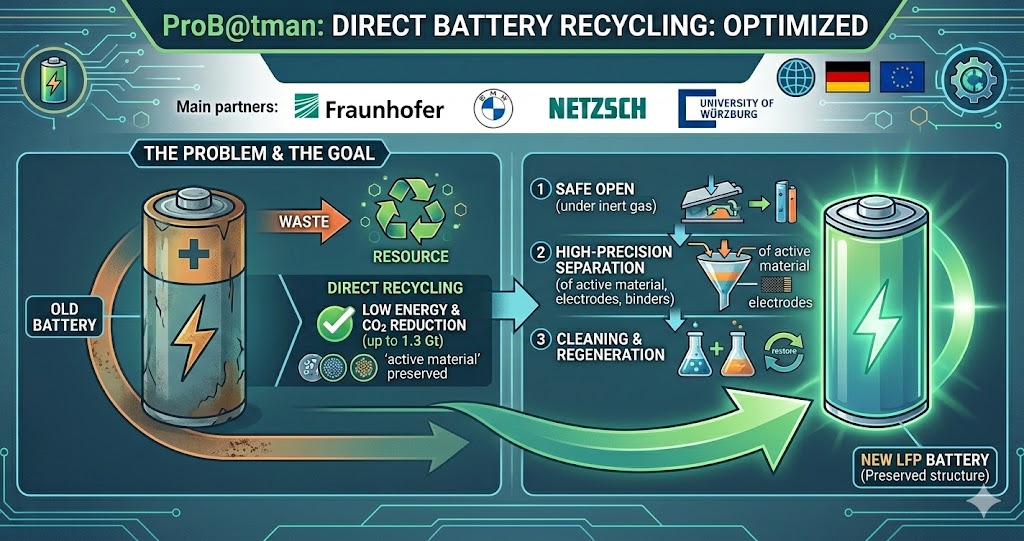
2026年2月23日、ドイツのフラウンホーファー研究機構(FZEB)を中心に、BMWやNetzsch、ヴュルツブルク大学などを含む産学コンソーシアムが、リチウムイオンバッテリーの「直接リサイクル」技術を最適化する共同プロジェクトProB@tmanを開始しました。
プロジェクトの背景と目的
- 廃棄物予測: 2040年までに年間約36万トンの使用済みバッテリーが発生すると予測されており、これを「廃棄物」ではなく「資源」として活用することが急務となっています。
- 現行手法の課題: 現在主流の「乾式冶金(加熱融解)」や「湿式冶金(化学溶解)」は、エネルギー消費が大きく、特定の金属(ニッケルやコバルト)しか回収できないという欠点があります。
- 直接リサイクルの追求: 材料を元素レベルまで分解せず、機能性を持った「活物質」のまま回収・再生することで、エネルギー消費を抑え、CO2排出量を最大1.3ギガトン(CO2換算)削減することを目指します。
技術的な特徴とプロセス
- 不活性ガス下での安全開封: バッテリーセルを安全に解体し、揮発性成分や電解質塩を効率よく回収。
- 高精度な分離技術: 活物質、電極材、バインダー(接着剤)を最新技術で分離。
- 洗浄と再生: 回収した材料を洗浄・分析し、特性を損なわない方法で再利用可能な状態へ処理。
- デジタルツインの活用: ライフサイクル分析やプロセス最適化のためにデジタル技術を導入し、技術成熟度を高めます。
関連情報と補足解説
1. なぜ「直接リサイクル」が必要なのか?
リチウムイオン電池の正極材は、近年「LFP(リン酸鉄リチウム)」などの安価な材料へとシフトしています。
- 経済性の維持: LFPには高価なニッケルやコバルトが含まれないため、従来の溶解による回収(湿式・乾式)ではコスト割れを起こす可能性があります。
- 構造の保持: 直接リサイクルであれば、高度な結晶構造を持つ活物質をそのまま再利用できるため、製造プロセスを大幅に短縮でき、経済的メリットが生まれます。
2. EU電池規則(EU Battery Regulation)との関連
このプロジェクトは、欧州で強化されている規制への直接的な回答となります。
- 回収義務とリサイクル率: 2027年以降、リチウムの回収率目標が段階的に引き上げられるほか、新品のバッテリーに「一定割合のリサイクル材料」を使用することが義務付けられます。ProB@tmanは、この法的要件をクリアするための技術基盤となります。
3. ドイツの戦略的立ち位置
BMWやJungheinrich(物流機器大手)、Trumpf(レーザー技術)といったドイツの有力企業が参画している点は重要です。
- 垂直統合: 車両メーカー(BMW)、設備メーカー(Trumpf)、リサイクル技術(Fraunhofer)が一体となることで、設計段階からリサイクルしやすさを考慮した「リサイクル・バイ・デザイン」の実現を狙っています。
まとめと今後の展望
ProB@tmanプロジェクトは、バッテリーを「材料の塊」としてではなく「精密な部品の集合体」として扱い、その価値を維持したまま循環させることを目指しています。これが実現すれば、2040年の大規模な廃棄ラッシュを、持続可能な資源供給へと変える画期的な転換点となります。
重要ポイント: 本プロジェクトは、従来の「溶かして抽出する」リサイクルから、「形を保って再生する」高度な資源循環へのシフトを象徴しています。
ProB@tman Project Launches in Germany: Optimizing Direct Battery Recycling Technology
On February 23, 2026, an industry-academic consortium led by the Fraunhofer Research Institution for Battery Cell Production (FZEB), and including BMW, Netzsch, and the University of Wurzburg, launched “ProB@tman.” This collaborative project aims to optimize “direct recycling” technologies for lithium-ion batteries.
Project Background and Objectives
- Waste Forecast: With an estimated 360,000 tons of end-of-life batteries expected annually by 2040, there is an urgent need to treat these as “resources” rather than “waste.”
- Challenges of Current Methods: Conventional pyrometallurgical (smelting) and hydrometallurgical (chemical leaching) processes are energy-intensive and often limited to recovering specific metals like nickel and cobalt.
- Pursuit of Direct Recycling: By recovering and regenerating “active materials” in their functional state—without breaking them down to the elemental level—the project aims to reduce energy consumption and cut CO2 emissions by up to 1.3 gigatons (CO2 equivalent).
Technical Features and Processes
- Safe Opening under Inert Gas: Safely dismantling battery cells to efficiently recover volatile components and electrolyte salts.
- High-Precision Separation: Utilizing advanced technology to separate active materials, electrode materials, and binders (adhesives).
- Cleaning and Regeneration: Analyzing and cleaning recovered materials to process them into a reusable state without compromising their properties.
- Digital Twin Utilization: Implementing digital technology for life-cycle analysis and process optimization to increase technical maturity.
Related Information and Contextual Commentary
1. Why is Direct Recycling Necessary?
Cathode materials in lithium-ion batteries are increasingly shifting toward more affordable options like LFP (Lithium Iron Phosphate).
- Economic Viability: Since LFP lacks expensive nickel and cobalt, traditional recycling (hydrometallurgy/pyrometallurgy) can be cost-prohibitive.
- Structural Preservation: Direct recycling allows the reuse of active materials with their complex crystal structures intact, significantly shortening the manufacturing process and creating economic advantages.
2. Connection to the EU Battery Regulation
This project serves as a direct response to strengthening European regulations.
- Recovery Mandates and Rates: From 2027 onward, lithium recovery targets will increase, and new batteries will be required to contain a minimum percentage of recycled content. ProB@tman provides the technical foundation to meet these legal requirements.
3. Germany’s Strategic Positioning
The participation of leading German companies such as BMW, Jungheinrich (logistics equipment), and Trumpf (laser technology) is significant.
- Vertical Integration: By uniting vehicle manufacturers (BMW), equipment manufacturers (Trumpf), and research institutions (Fraunhofer), the consortium aims to realize “Recycling-by-Design,” considering recyclability from the initial design stage.
Conclusion and Future Outlook
The ProB@tman project treats batteries not as mere “clumps of material” but as “assemblies of precision components,” aiming to circulate them while maintaining their inherent value. Success here would mark a historic turning point, transforming the massive battery waste influx of 2040 into a sustainable resource supply.
Key Point: This project symbolizes a shift from traditional “melt-and-extract” recycling to an advanced circular economy model of “preserve-and-regenerate.”
コメント