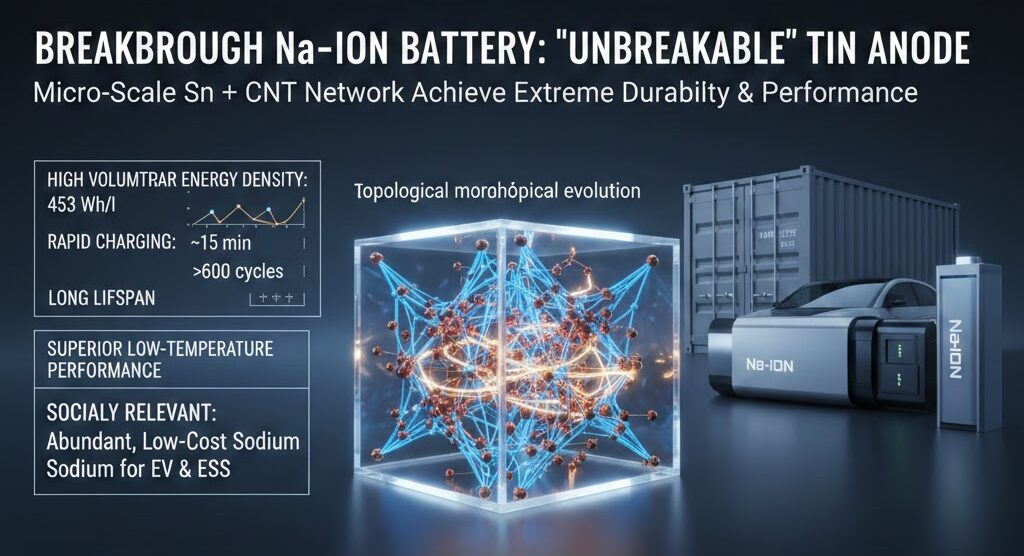
この研究は、次世代蓄電池として期待されるナトリウムイオン電池(NIB)において、理論容量は高いものの劣化が激しかったスズ(Sn)アノードの実用性を劇的に向上させたものです。
1. 研究の背景と課題
- 合金系アノードの利点: スズ(Sn)などの合金系材料は、従来のグラファイトと比較して高い体積エネルギー密度を実現できます。
- 従来の弱点: 充電・放電時に大きな体積変化(膨張・収縮)が起こり、材料が微細化(粉砕)されることで電気的接触が失われ、サイクル寿命が極端に短くなる課題がありました。
- これまでの対策の限界: 膨張を抑えるために材料をナノ化したり、緩衝材を多量に混ぜたりする方法は、コストや製造効率(スケーラビリティ)を損なう傾向にありました。
2. 本研究の革新的なポイント
- マイクロメートルスケールの採用: 製造が容易で実用的な「マイクロメートルサイズ」のスズ粒子を使用しながら、高い耐久性を実現しました。
- CNTネットワークの活用: 単層カーボンナノチューブ(SWCNT)による架橋ネットワークを導入。これにより、スズ粒子が膨張・収縮しても電気的なつながりを維持し続ける「トポロジカルな形態進化」を制御することに成功しました。
- マルチスケール解析: 機械学習を用いた定量分析と多角的な評価により、充放電中の材料の動きを解明しました。
3. 主要な成果と性能指標
- 高い体積エネルギー密度: 453 Wh/l という、実用レベルの高い数値を達成。
- 優れた急速充電性能: 約15分での急速充電が可能。
- 長寿命: 600サイクル以上の安定した動作を確認。
- 低温耐性: 既存のリチウムイオン電池(LFP/グラファイト系)よりも、低温環境下での動作特性が優れていることが示されました。
関連情報の補足:なぜこの研究が重要なのか
ナトリウムイオン電池(NIB)の立ち位置
リチウムは産出地が偏在しており、価格変動のリスクがあります。一方、ナトリウムは塩などから安価かつ無限に入手可能であるため、電気自動車(EV)や大型蓄電システム(ESS)のコストダウンの切り札とされています。
合金系材料のポテンシャル
現在主流のハードカーボン(難黒鉛化炭素)アノードは安定していますが、容量に限界があります。スズ(Sn)を使用することで、電池をよりコンパクトに(高体積エネルギー密度に)できるため、限られたスペースに多くの電力を詰め込む必要があるEV等に最適です。
今後の展望
この研究により、「合金系は脆い」という常識が覆され、マイクロメートルサイズという低コストな材料で長寿命化が可能であることが証明されました。これにより、リチウムイオン電池に匹敵、あるいは一部の性能(低温特性やコスト)で凌駕する次世代NIBの実用化が加速すると予想されます。
出典:https://www.nature.com/articles/s41560-026-01974-2
Development of High-Density Tin Alloy Anodes for Sodium-Ion Batteries with Superior Fast-Charging and Low-Temperature Performance
This study dramatically improves the practicality of tin (Sn) anodes for Sodium-Ion Batteries (NIBs)—a promising next-generation storage technology. While Sn anodes offer high theoretical capacity, they previously suffered from severe degradation.
1. Research Background and Challenges
- Advantages of Alloy Anodes: Alloy-based materials like tin (Sn) can achieve higher volumetric energy density compared to conventional graphite.
- Conventional Weaknesses: Large volume changes (expansion and contraction) during charging and discharging lead to material pulverization. This causes a loss of electrical contact and results in an extremely short cycle life.
- Limitations of Previous Solutions: Strategies to suppress expansion—such as nanosizing materials or adding large amounts of buffering agents—tended to compromise cost-effectiveness and manufacturing scalability.
2. Innovative Points of This Research
- Adoption of Micrometer Scale: The team achieved high durability using “micrometer-sized” tin particles, which are practical and easy to manufacture.
- Utilization of CNT Networks: By introducing a bridging network of single-walled carbon nanotubes (SWCNTs), they successfully controlled the “topological morphological evolution.” This ensures the tin particles maintain electrical connectivity despite repeated expansion and contraction.
- Multi-scale Analysis: Quantitative analysis assisted by machine learning and multi-dimensional evaluations clarified the material behavior during charge and discharge cycles.
3. Key Achievements and Performance Metrics
- High Volumetric Energy Density: Achieved a practical level of 453 Wh/l.
- Excellent Fast-Charging: Capable of fast-charging in approximately 15 minutes.
- Long Cycle Life: Confirmed stable operation for over 600 cycles.
- Low-Temperature Resilience: Demonstrated superior operating characteristics at low temperatures compared to existing Lithium-ion batteries (LiFePO4/graphite systems).
Supplementary Information: Why This Research Matters
The Role of Sodium-Ion Batteries (NIBs)
Lithium resources are geographically concentrated, posing risks of price volatility. In contrast, sodium is abundantly and cheaply available from sources like salt. Therefore, NIBs are seen as a “game-changer” for reducing costs in Electric Vehicles (EVs) and Large-scale Energy Storage Systems (ESS).
The Potential of Alloy-Based Materials
Current mainstream hard carbon (non-graphitizable carbon) anodes are stable but have capacity limits. Using tin (Sn) allows batteries to be more compact (higher volumetric energy density), making them ideal for EVs and other applications where space is limited.
Future Outlook
This research overturns the conventional wisdom that “alloy systems are too brittle.” By proving that long life can be achieved with low-cost micrometer-sized materials, it accelerates the commercialization of next-generation NIBs that could rival or even surpass Lithium-ion batteries in terms of low-temperature performance and cost.
コメント