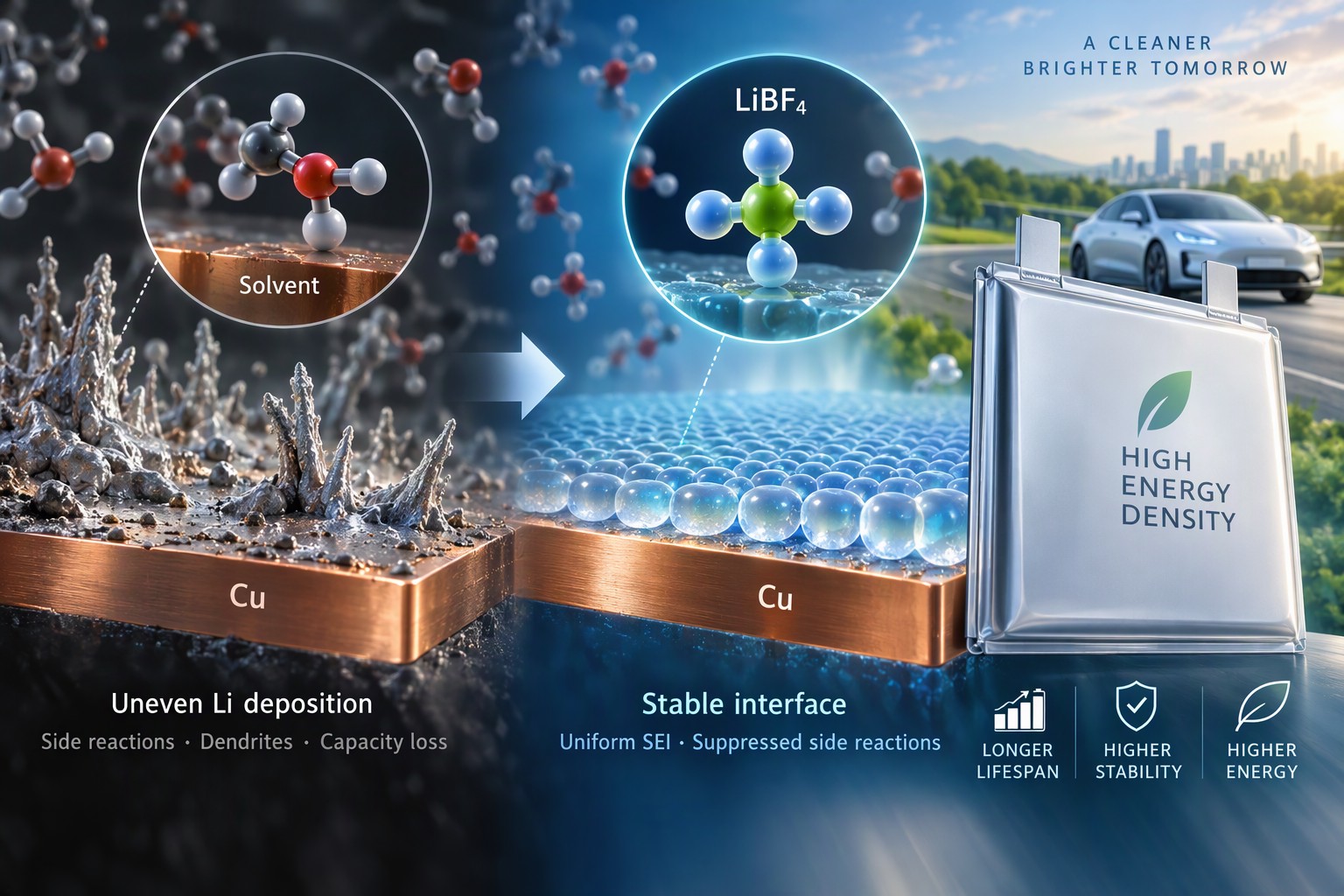
次世代リチウム金属電池の性能を大きく左右する、電解液と負極基板(銅など)の界面における相互作用のメカニズムに関する研究成果が発表されました。高エネルギー密度化が期待される一方で実用化のハードルとなっている「アノードフリー(初期リチウム金属不使用)電池」の課題に対し、電解液成分の吸着特性を活用した革新的なアプローチが示されています。
研究の背景と課題
初期アノードフリーリチウム金属電池は、充電時にその場でリチウム金属を析出させることでエネルギー密度を極限まで高められる次世代プラットフォームとして期待されています。しかし、銅(Cu)集電体は本質的にリチウムを弾きやすい性質(リチオフォビック性)を持つため、リチウム堆積時に過電圧が生じ、電解液とリチウム間の寄生反応(副反応)が引き起こされます。これにより活性リチウムが不可逆的に失われ、急速な容量低下やデンドライトの成長を招くことが実用化の重大なボトルネックとなっていました。
主要な発見とメカニズム
韓国科学技術院(KAIST)などの研究チームは、計算科学(DFT/MDシミュレーション)および原子間力顕微鏡(KPFM)などの先端分析を用い、電解液成分の吸着エネルギーが界面層の形成や固体電解質相間(SEI)の安定性に与える影響を解明しました。
- 溶媒優位な界面と分解のメカニズム: 多くの有機溶媒は、ファンデルワールス分散力によってリチウム塩化合物よりも強く銅表面に吸着する傾向があります。そのため、電池組み立て直後は溶媒優位の界面層が形成されますが、初期充電時の銅酸化物の電気化学的還元に伴い急速な組成再構築が起こり、不安定なSEIの進化や非一様なリチウムめっきを引き起こします。
- テトラフルオロホウ酸塩(LiBF4)による安定化: 研究チームは、銅表面に対して有機溶媒よりも強い吸着選好性を示すテトラフルオロホウ酸リチウム(LiBF4)を導入しました。対象的な等方性電荷分布を持つコンパクトなBF4アニオンは、銅表面やネイティブ酸化銅に強く結合し、電子的にパッシベーション(不働態化)されたホモジナイogenousな(均一な)アニオン駆動型界面層を形成します。
- 耐食性とリチウム可逆性の向上: BF4由来の無機SEIは、リチウム堆積・剥離時のガルバニック腐食や化学腐食を効果的に抑制し、電子絶縁性を維持しながら副反応を大幅に低減します。
電気化学的性能と実証結果
- 優れたサイクル寿命: 高負荷なNCM90正極(4.1mAh/cm2、正極容量ローディング)および貧電解液条件(1.5g/Ah、4μL/cm2)の下で評価を行った結果、LiBF4含有電解液を用いたセルは、300サイクル後でも初期放電容量の62%を維持する優れたサイクル安定性と高いクーロン効率を実証しました。
- 大規模パウチセルでの検証: コインセルだけでなく、1.29Ah規模の積層型パウチセル(セル全体のエネルギー密度が約496.1Wh/kg、体積エネルギー密度が約703.7Wh/L)においても、優れたサイクル安定性が維持されることが確認され、実用的なデバイスへの適用可能性が示されています。
今後の展望
本研究は、従来のバルク物性(イオン伝導度や粘度など)の最適化に加え、電解液成分と銅表面との間の「界面相互作用エネルギー」を制御することが、アノードフリーリチウム金属電池の寿命向上と不可逆容量損失の抑制に向けた極めて有効な設計指針になることを提示しています。今後は、銅以外の集電体表面化学への展開や、より多様な系での実用化に向けた研究の進展が期待されます。
出典:https://www.nature.com/articles/s41467-026-79429-1
Significant Improvement in Anode-Free Battery Lifespan: Elucidating the Interface Stabilization Mechanism via Electrolyte Anion Adsorption Control
Research findings have been published regarding the interaction mechanism at the interface between the electrolyte and negative electrode substrates (such as copper), which significantly influences the performance of next-generation lithium-metal batteries. While high energy density is expected, “anode-free” (initially lithium-metal-free) batteries face practical hurdles; to address these challenges, an innovative approach utilizing the adsorption characteristics of electrolyte components has been demonstrated.
Research Background and Challenges Initially anode-free lithium-metal batteries are anticipated as a next-generation platform that maximizes energy density by depositing lithium metal in situ during charging. However, because copper (Cu) current collectors inherently possess lithium-repelling properties (lithiophobicity), overpotentials occur during lithium deposition, triggering parasitic (side) reactions between the electrolyte and lithium deposits. This leads to the irreversible loss of active lithium, resulting in rapid capacity decay and dendrite growth, which has been a critical bottleneck for practical implementation.
Key Findings and Mechanisms A research team including the Korea Advanced Institute of Science and Technology (KAIST) utilized computational science (DFT/MD simulations) and advanced analytics such as Kelvin probe force microscopy (KPFM) to clarify the influence of electrolyte component adsorption energies on interfacial layer formation and solid electrolyte interphase (SEI) stability.
- Solvent-Dominated Interface and Decomposition Mechanism: Most organic solvents tend to adsorb onto the copper surface more strongly than lithium-salt compounds through van der Waals dispersion interactions. Consequently, a solvent-dominated interfacial layer forms immediately after cell assembly; however, rapid compositional reconstruction occurs during the electrochemical reduction of copper oxides upon initial charging, leading to unstable SEI evolution and non-uniform lithium plating. 20261116アノードフリーへのアニオンの影響.pdf
- Stabilization via Lithium Tetrafluoroborate (LiBF4): The team introduced lithium tetrafluoroborate (LiBF4), which exhibits a stronger adsorption preference for copper surfaces than organic solvents. The compact BF4 anions, possessing a symmetrical and isotropic charge distribution, bind strongly to the copper surface and native copper oxides, forming an electronically passivated, homogeneous, anion-driven interfacial layer.
- Enhanced Corrosion Resistance and Lithium Reversibility: The BF4-derived inorganic SEI effectively suppresses galvanic and chemical corrosion during lithium deposition and stripping, substantially reducing side reactions while maintaining electronic insulation.
Electrochemical Performance and Experimental Results
- Superior Cycle Life: Evaluated under high-loading NCM90 positive electrode conditions (4.1 mAh cm-2 positive electrode loading) and lean electrolyte conditions (1.5 g Ah-1 and 4 uL cm-2), cells containing the LiBF4-based electrolyte demonstrated excellent cycle stability and high Coulombic efficiency, retaining 62% of their initial discharge capacity even after 300 cycles.
- Validation in Large-Format Pouch Cells: It was confirmed that excellent cycle stability is maintained not only in coin cells but also in 1.29 Ah stacked pouch cells (achieving a cell-level specific energy of approximately 496.1 Wh kg-1 and a volumetric energy density of approximately 703.7 Wh L-1), demonstrating applicability to practical devices.
Future Outlook This study suggests that in addition to optimizing conventional bulk properties (such as ionic conductivity and viscosity), controlling the “interfacial interaction energy” between electrolyte components and the copper surface serves as an extremely effective design guideline for improving the lifespan of anode-free lithium-metal batteries and suppressing irreversible capacity loss. Moving forward, further research progress is expected toward expanding this approach to current collector surface chemistry beyond copper and applying it to more diverse systems.

コメント