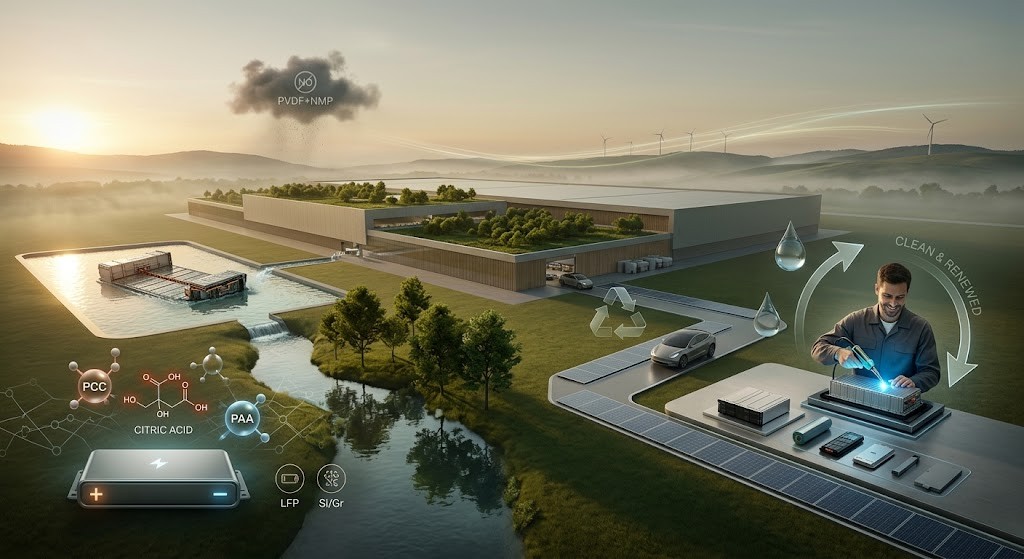
電動化が進む現代において、リチウム電池の製造プロセスにおける環境負荷低減とリサイクル性の向上は、持続可能な社会に向けた重要な課題となっています。カリフォルニア大学サンディエゴ校(UCSD)やトヨタ自動車北米研究所などの研究チームは、フッ素を含まない水系バインダーを用いた画期的な技術を「Nature Communications」誌上で発表しました。ここではその詳細と関連情報を分かりやすくまとめました。
1. 従来のバッテリー製造が抱える環境・コスト面の課題
従来のフッ化物系バインダーや溶剤を用いた製造工程には、いくつかの大きな課題が存在していました。
- フッ素系バインダーと有毒溶剤の使用: リチウムイオン電池の製造では、主にポリフッ化ビニリデン(PVDF)バインダーと、有毒な有機溶剤であるN-メチル-2-pyrrolidone(NMP)が広く使われてきました。これらはコストがかかるだけでなく、環境や健康・安全面での管理を複雑にしています。
- リサイクル時の障壁: PVDFに含まれる強固なC-F結合や分解副生物(フッ化リチウムや有機フッ素フラグメントなど)は、 active material(活物質)から分離しにくく、熱分解時などに有害な副生物を生成して環境負荷やリサイクルコストの増大を招いていました。
2. 新開発のフッ素フリー水系バインダー「PCC」の仕組みと特徴
研究チームが開発したPCCバインダーは、クエン酸(CA)を架橋剤として用いて、ポリアクリル酸(PAA)とカルボキシメチルセルロース(CMC)を水中で架橋させたフッ素フリーのポリマーネットワークです。
- 多重結合による高い機械的・熱的安定性: バインダー鎖の間や活物質、集電体との間で、水素結合、共有結合(エステル結合)、イオン結合を統合し、強固なネットワークを形成します。これにより、高い導電性や酸化安定性を維持しながら、塗膜のひび割れを防ぎます。
- 優れた電気化学性能: リン酸鉄リチウム(LFP)や高電圧正極(NCM811など)、さらにはシリコンやグラファイトなどの負極に至るまで、幅広い電極材料に適用可能です。LFPを用いた正極では、従来のPVDFと同等の初期容量を維持しつつ、優れたサイクル安定性を示しました。
3. 持続可能なダイレクト・リサイクルとライフサイクルアセスメント(LCA)
PCCバインダーの導入は、電池の寿命を迎えた後のリサイクルプロセスや環境フットプリントにも大きな変革をもたらします。
- フッ素残渣のないダイレクト・リサイクル: PCCバインダーは水溶性を持つため、使用済み電極を穏やかな水に浸すだけで活物質を集電体から効率よく剥離・回収できます。回収されたLFPやグラファイトはフッ素残留物(Fコンタミ)を含まず、新品同等の性能に再生可能です。
- 環境負荷とコストの削減: グリート(GREET)などのモデルを用いたライフサイクル評価(LCA)では、PVDFおよびNMPをPCCと水に置き換えることで、製造時の温室効果ガス(GHG)排出量やエネルギー需要、水消費量、コストをいずれも削減できることが示されています。リサイクル工程においても、収益性の向上や環境負荷の低減(GHG排出量の削減など)に寄与します。
出典:https://www.nature.com/articles/s41467-026-78215-3
Moving Toward Toxic Solvent-Free and Fluorine-Free Battery Manufacturing! Substantial Reductions in Environmental Burden and Cost Brought by the Aqueous “PCC” Binder
In today’s advancing electrification, reducing the environmental impact of lithium battery manufacturing processes and improving recyclability have become critical goals for a sustainable society. A research team including the University of California San Diego (UCSD) and the Toyota Research Institute of North America published a breakthrough technology utilizing a fluorine-free aqueous binder in the journal Nature Communications. Below is a clear overview of the details and related context.
1. Environmental and Cost Challenges of Conventional Battery Manufacturing Conventional manufacturing processes using fluoride-based binders and solvents have faced several major challenges:
- Use of Fluorine-Based Binders and Toxic Solvents: In the manufacture of lithium-ion batteries, polyvinylidene fluoride (PVDF) binders and the toxic organic solvent N-methyl-2-pyrrolidone (NMP) have been widely used. These not only incur high costs but also complicate environmental, health, and safety management.
- Barriers in Recycling: The strong C-F bonds and decomposition byproducts (such as lithium fluoride and organic fluorine fragments) contained in PVDF are difficult to separate from active materials, generating hazardous byproducts during thermal decomposition and leading to increased environmental burdens and recycling costs.
2. Mechanism and Features of the Newly Developed Fluorine-Free Aqueous “PCC” Binder The PCC binder developed by the research team is a fluorine-free polymer network in which polyacrylic acid (PAA) and carboxymethyl cellulose (CMC) are crosslinked in water using citric acid (CA) as a crosslinking agent.
- High Mechanical and Thermal Stability via Multiple Bonds: It integrates hydrogen bonds, covalent bonds (ester bonds), and ionic bonds among the binder chains, active materials, and current collectors to form a robust network. This prevents coating cracking while maintaining high electrical conductivity and oxidative stability.
- Superior Electrochemical Performance: It is applicable to a wide range of electrode materials, from lithium iron phosphate (LFP) and high-voltage cathodes (such as NCM811) to anodes like silicon and graphite. LFP-based cathodes maintained initial capacity equivalent to conventional PVDF while exhibiting superior cycle stability.
3. Sustainable Direct Recycling and Life Cycle Assessment (LCA) The introduction of the PCC binder also brings revolutionary changes to post-lifespan recycling processes and environmental footprints.
- Fluorine-Residue-Free Direct Recycling: Because the PCC binder is water-soluble, active materials can be efficiently peeled and recovered from current collectors simply by soaking used electrodes in mild water. The recovered LFP and graphite contain no fluorine residues (F-contamination) and can be regenerated to pristine-level performance.
- Reduction of Environmental Impact and Costs: Life cycle assessments (LCA) using models such as GREET showed that replacing PVDF and NMP with PCC and water reduces manufacturing-stage greenhouse gas (GHG) emissions, energy demand, water consumption, and costs. In the recycling process, it also contributes to improved profitability and reduced environmental impacts (such as lowered GHG emissions).


コメント