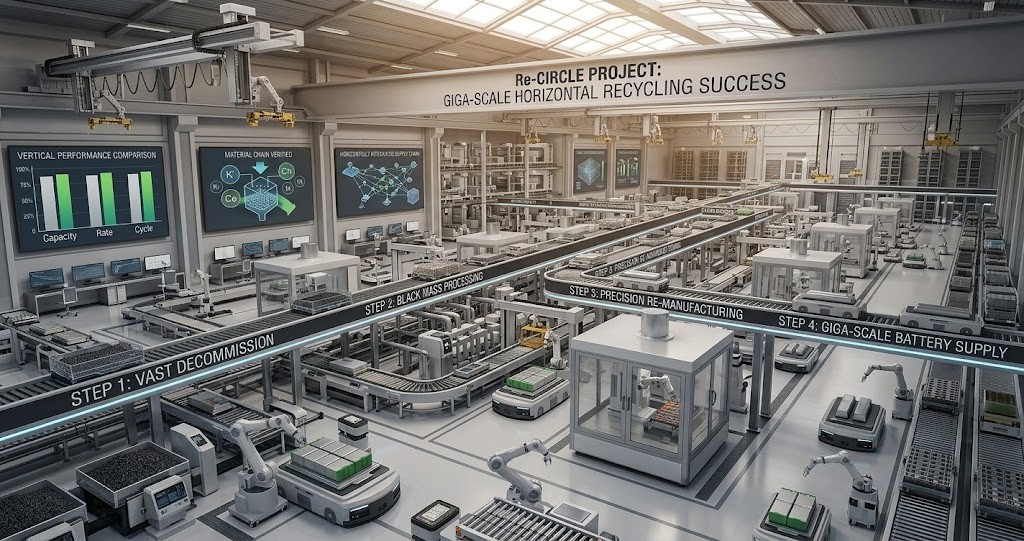
マークテックやEFTなど6社が進める「Re-CIRCLEプロジェクト」により、使用済みリチウムイオン電池(LIB)の水平リサイクル(Battery-to-Battery)実証が成功を収めました。
従来はコスト・品質面で困難とされていたブラックマスからの高純度レアメタル抽出と電池再生において、新規資源と同等の性能(充放電容量・レート特性・サイクル特性など)を実証した点は、持続可能な電池サプライチェーン構築における重要なマイルストーンです。
本ニュースの要点と、業界・技術的な背景を補足した関連情報を以下の通り整理しました。
ニュースの主要ポイント
- 実証実験の成果: 使用済みLIBから生成した高純度ブラックマスより抽出したレアメタルを用いて試作電池を作成。新規資源(市販の炭酸リチウム等)を用いた電池と同等水準の性能(電極の体積/界面抵抗、0.1C〜2Cのレート特性、サイクル特性)を確認。
- 主要採用技術: エマルションフローテクノロジーズ(EFT)が開発した独自の溶媒抽出技術「エマルションフロー技術」を活用し、高純度レアメタルを回収。
- 参画企業6社と役割分担:
- マークテック / リーテックRES: 電池回収・ブラックマス生成・プラント運用
- EFT (エマルションフローテクノロジーズ): エマルションフロー技術によるレアメタル抽出・精製
- KDDI / トランスコスモス: DX・トレーサビリティー管理・デジタル基盤
- 商船三井ロジスティクス: 危険物輸送を含む循環型物流ネットワークの構築
- プロジェクト枠組み: リチウムイオンバッテリーの資源循環確立を目指す「Re-CIRCLEプロジェクト」の一環。
技術・業界背景(関連情報)
1. 抽出技術「エマルションフロー」の特徴
- 原理: 油相と水相を流体運動(油水混合)のみで送液・混合し、高速かつ効率的に目的成分(リチウム、コバルト、ニッケル等)を分離抽出する技術。
- 従来のハイドロメタラジー(湿式製錬)と比較してミキサーセトラなどの設備をコンパクト化でき、高効率・低コスト・低環境負荷でのレアメタル回収が可能とされる。
2. 背景にあるグローバル規制(EU電池規制など)
- EUでは「欧州電池規制(EU Battery Regulation)」により、一定割合以上のリサイクル原料(コバルト、リチウム、ニッケル等)の使用義務化や、サプライチェーン全体を追跡する「バッテリーパスポート」の導入が進められている。
- 本プロジェクトでKDDIや商船三井ロジスティクスが参画し、輸送およびトレーサビリティーを重視している点は、こうした国内外の厳格な環境規制・デジタルデータ連携への対応を見据えたもの。
3. 「水平リサイクル」確立に向けた今後の課題
- ブラックマス供給の安定化: 回収ルートの整備と処理能力の拡大。
- プロセス全体の採算性: 試作段階から商業スケール(量産プラント)への移行時におけるコスト競争力の確保。
- 不純物制御: 多種多様な化学組成(NCM、LFP等)の廃棄電池が混在する中での、一定品質の維持。
出典:https://monoist.itmedia.co.jp/mn/articles/2608/25/news023.html
Covering Traceability to Logistics: 6-Company Consortium Advances Social Implementation of Closed-Loop LIB Recycling
Under the “Re-CIRCLE Project” spearheaded by six companies including Marktec and Emulsion Flow Technologies (EFT), a demonstration of closed-loop (Battery-to-Battery) recycling for spent lithium-ion batteries (LIBs) has yielded successful results.
Demonstrating performance equivalent to virgin materials—across metrics such as charge/discharge capacity, rate capability, and cycle performance—in extracting high-purity critical metals from black mass and remanufacturing battery cells, a process historically deemed difficult due to cost and quality issues, represents a key milestone in building a sustainable battery supply chain.
Key takeaways from this news, alongside relevant background context on the industry and technology, are detailed below.
Key Points
- Demonstration Results: Prototype battery cells were fabricated using critical metals extracted from high-purity black mass generated from spent LIBs. The prototype exhibited performance on par with cells made from virgin materials (such as commercially available lithium carbonate), covering volumetric/interfacial electrode resistance, rate characteristics from 0.1C to 2C, and cycle life.
- Core Technology: High-purity critical metals were recovered utilizing “Emulsion Flow Technology,” a proprietary solvent extraction technology developed by Emulsion Flow Technologies (EFT).
- Participating Companies & Roles:
- Marktec / Re-Tech RES: Battery collection, black mass generation, and plant operation
- EFT (Emulsion Flow Technologies): Extraction and refining of critical metals via Emulsion Flow Technology
- KDDI / transcosmos: DX, traceability management, and digital infrastructure
- MOL Logistics: Establishment of a circular logistics network, including hazardous materials transportation
- Project Framework: Conducted as part of the “Re-CIRCLE Project,” which aims to establish a circular economy for lithium-ion batteries and enable sustainable recycling.
Technical & Industry Background
1. Characteristics of “Emulsion Flow” Extraction Technology
- Mechanism: A technology that feeds and mixes organic and aqueous phases using fluid dynamics alone (oil-water mixing), achieving high-speed and efficient separation and extraction of target elements (lithium, cobalt, nickel, etc.).
- Advantages: Compared to conventional hydrometallurgy, it enables more compact equipment than traditional mixer-settlers, facilitating high-efficiency, low-cost, and environmentally friendly recovery of critical metals.
2. Global Regulatory Context (e.g., EU Battery Regulation)
- Regulatory Environment: Under the EU Battery Regulation, mandates are being introduced for minimum recycled content targets (for cobalt, lithium, nickel, etc.) alongside the implementation of a “Battery Passport” to trace the entire supply chain.
- Strategic Intent: The participation of KDDI and MOL Logistics to emphasize transportation and traceability reflects strategic preparation for strict domestic and international environmental regulations and digital data integration.
3. Future Challenges for Establishing Closed-Loop Recycling
- Securing Stable Black Mass Supply: Developing collection routes and expanding processing capacity.
- Process-Wide Economic Viability: Ensuring cost competitiveness when transitioning from the prototype phase to commercial-scale mass production plants.
- Impurity Control: Maintaining consistent quality despite mixed input streams of spent batteries with varied chemistries (NCM, LFP, etc.).


コメント