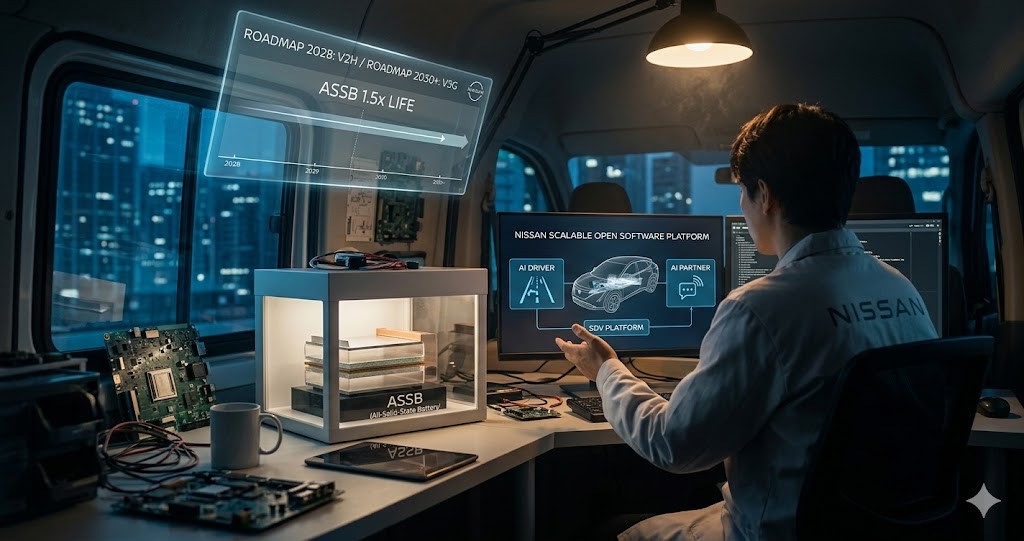
日産自動車が掲げる次世代のモビリティ戦略は、単なる「移動手段の電動化」に留まりません。ソフトウェアが車両の機能を規定するSDV(Software Defined Vehicle)化と、エネルギー密度の限界を打破する全固体電池の開発を両輪とし、100年に一度と言われる変革期を勝ち抜こうとしています。
2026年4月の技術説明会で明かされた、日産の「AIドリブン車」と「全固体電池」の現在地と今後の展望について解説します。
1. AIドリブン車とSDVプラットフォームの戦略
日産は独自のソフトウェア基盤「Nissan Scalable Open Software Platform」を軸に、2つのAI技術を統合する計画です。
- AIドライブ技術(自動運転・運転支援) エンドツーエンド(E2E)AIを採用し、日産が培ってきた高精度な車両制御技術と融合。熟練ドライバーのような周囲と調和した安全な運転を目指します。
- AIパートナー技術(車内アシスタント) ユーザーの日常的な行動や会話の文脈を学習し、「成長するパートナー」としてルート変更の提案や到着連絡などを能動的に行います。
- ソフトウェアの階層化と標準化 車両の根幹を支える「ビークルOS」やミドルウェアは自社で管理しつつ、アプリケーション層や汎用的なAPIについては外部との共通化・標準化を進めることで、開発コストの抑制と迅速な価値提供を両立させます。
2. 全固体電池(ASSB):電気自動車のゲームチェンジャー
EVの課題である「航続距離・充電時間・価格」を解決する切り札として、全固体電池の開発に注力しています。
- 技術的な進捗 23積層の車載大サイズセルの試作が完了し、設計通りの充放電性能を確認済みです。従来の液体リチウムイオン電池(LIB)と比較して、寿命は1.5倍以上の向上が見込まれています。
- 主な採用技術
- ドライ正極: 製造工程の簡素化と環境負荷低減に寄与。
- リチウム金属負極: 銅箔上にリチウムを析出させる方式で、高いエネルギー密度を実現。
- 今後のロードマップ 2028年度には少量の公道試験を開始する計画です。将来的には電池コストを液体LIBの2割から3割程度削減できるポテンシャルを秘めていますが、初期段階では材料の安定確保と生産スケールの拡大が最大の課題となります。
3. エネルギーエコシステムへの展開(V2H/V2G)
日産はEVを単なる乗り物ではなく、社会インフラの一部として定義しています。
- V2H(Vehicle to Home): 2028年に本格展開。EVの電力を家庭で活用する仕組みを低価格で提供します。
- V2G(Vehicle to Grid): 2030年以降、EVを地域の電力網に接続し、電力需給の調整に活用するビジネスへの参入を目指します。
- データ活用: 個々の車両の電力使用状況をリアルタイムで把握し、ユーザーの利便性を損なわない範囲で電力マネジメントを行うVPP(仮想発電所)スキームの構築を進めています。
関連情報:全固体電池とリチウム金属負極の重要性
日産が採用を明言した「リチウム金属負極」は、次世代電池において極めて重要な技術です。
- エネルギー密度の飛躍: 従来の黒鉛(グラファイト)負極に比べ、理論上の容量が非常に高く、電池の小型・軽量化に直結します。
- 黒鉛負極の理論容量:約 372 mAh/g
- リチウム金属の理論容量:約 3860 mAh/g
- 全固体化との親和性: 液体電解質ではリチウム金属の使用時に「デンドライト(樹枝状結晶)」が発生して短絡(ショート)するリスクが高いですが、固体電解質を用いることでこの物理的な抑制が期待されています。
日産は、2028年度のパイロット生産開始に向け、横浜工場内に試作生産ラインを構築するなど、実用化に向けた最終段階に入っています。
出典:https://kuruma-news.jp/post/1048485
Lithium Metal Anode and 23-Layer Cells: Nissan’s All-Solid-State Battery Development Enters “According to Design” Phase
Nissan Motor’s next-generation mobility strategy goes beyond the simple “electrification of transportation.” By driving forward both SDV (Software Defined Vehicle) technology, where software defines vehicle functions, and the development of all-solid-state batteries that break through energy density limits, the company aims to lead in this once-in-a-century industry transformation.
This report explains the current status and future outlook of Nissan’s “AI-driven vehicles” and “all-solid-state batteries,” as revealed at the April 2026 technology briefing.
1. Strategy for AI-Driven Vehicles and SDV Platforms
Nissan plans to integrate two core AI technologies centered on its proprietary “Nissan Scalable Open Software Platform.”
- AI Drive Technology (Autonomous Driving & Driver Assistance): By adopting End-to-End (E2E) AI and fusing it with Nissan’s long-standing high-precision vehicle control technology, the company aims for safe driving that harmonizes with its surroundings, much like a skilled human driver.
- AI Partner Technology (In-car Assistant): This technology learns the user’s daily behavior and conversational context to act as a “growing partner,” proactively suggesting route changes or sending arrival notifications.
- Software Layering and Standardization: While Nissan will internally manage the “Vehicle OS” and middleware that form the vehicle’s foundation, it will pursue commonality and standardization for application layers and general-purpose APIs. This approach balances development cost control with the rapid delivery of new value.
2. All-Solid-State Batteries (ASSB): The EV Game Changer
Nissan is focusing on ASSB development as the ultimate solution to the EV challenges of “range, charging time, and price.”
- Technical Progress: Prototyping of 23-layer large-scale automotive cells is complete, with charge-discharge performance confirmed to be “according to design.” Battery life is expected to improve by more than 1.5 times compared to conventional liquid lithium-ion batteries (LIB).
- Core Technologies:
- Dry Electrode: Contributes to simplifying the manufacturing process and reducing environmental impact.
- Lithium Metal Anode: Realizes high energy density by depositing lithium directly onto copper foil.
- Future Roadmap: Public road testing with a small fleet is planned for fiscal year 2028. While there is potential to reduce battery costs by 20% to 30% compared to liquid LIB in the long term, the primary challenges in the initial stages will be securing a stable material supply and scaling up production.
3. Expansion into the Energy Ecosystem (V2H/V2G)
Nissan defines the EV not just as a vehicle, but as part of the social infrastructure.
- V2H (Vehicle to Home): Full-scale rollout in 2028. Nissan will provide affordable systems to utilize EV power for home use.
- V2G (Vehicle to Grid): From 2030 onwards, the company aims to enter the business of adjusting regional power supply and demand by connecting EVs to the grid.
- Data Utilization: Nissan is building a VPP (Virtual Power Plant) scheme that monitors the power status of individual vehicles in real-time to manage energy without compromising user convenience.
Related Information: The Importance of Lithium Metal Anodes
The “lithium metal anode” adopted by Nissan is a pivotal technology for next-generation batteries.
- Leap in Energy Density: Compared to conventional graphite anodes, the theoretical capacity is extremely high, directly leading to smaller and lighter batteries.
- Theoretical capacity of graphite anode: approx. 372 mAh/g
- Theoretical capacity of lithium metal: approx. 3860 mAh/g
- Compatibility with Solid-State Technology: In liquid electrolytes, the use of lithium metal poses a high risk of short circuits due to “dendrites” (needle-like crystals). The use of solid electrolytes is expected to physically suppress this growth.
Nissan is now in the final stages of practical application, including the establishment of a pilot production line at its Yokohama Plant for the start of pilot production in fiscal year 2028.

コメント