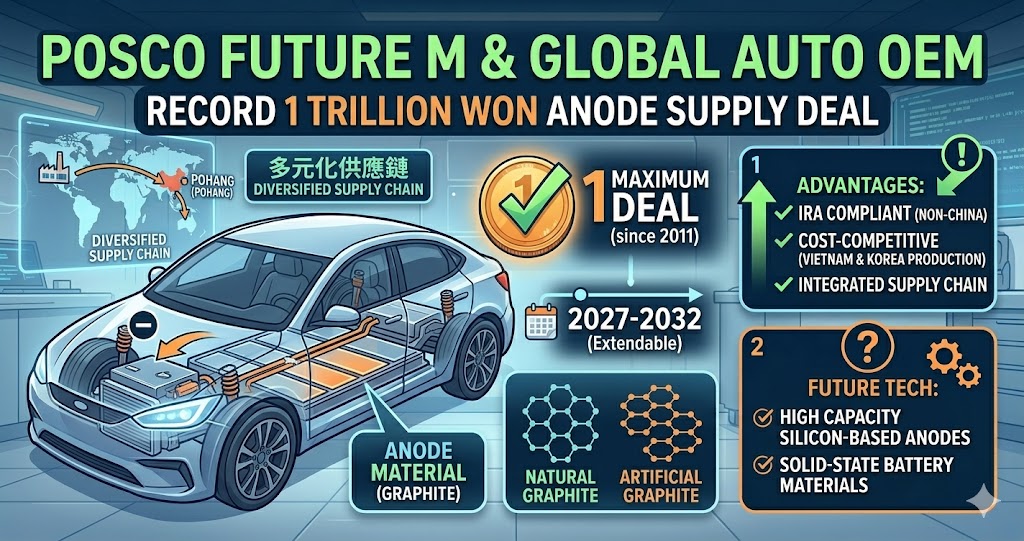
韓国の電池材料メーカー、ポスコフューチャーMは2026年3月16日、グローバル自動車メーカーとの間で、電気自動車(EV)用バッテリー負極材の供給に関する1兆ウォン(約6億6820万ドル)規模の契約を獲得したと発表しました。
主なポイント
- 契約規模: 1兆ウォン(2011年の事業参入以来、最大)
- 期間: 2027年から2032年まで(延長オプションあり)
- 供給品目: 人工黒鉛および天然黒鉛負極材
- 顧客: 非公開(世界的な自動車メーカー)
- 生産拠点: 韓国・浦項(ポハン)工場およびベトナムの新工場
関連情報の解説
ニュースをより深く理解するための、技術的・戦略的な補足情報です。
1. 負極材(Anode)とは
リチウムイオン電池の4大材料(正極材、負極材、電解液、セパレーター)の一つで、充電時にリチウムイオンを受け入れる役割を担います。
- 天然黒鉛: 安価で容量が大きいが、充放電による膨張が起きやすい。
- 人工黒鉛: 高温処理を経て作られ、結晶構造が安定しているため、急速充電性能や長寿命に優れています。
- 次世代材料: 同社は、さらに高容量なシリコン系負極材や、全固体電池向け材料の開発も進めています。
2. サプライチェーンの脱・中国依存
現在、世界の黒鉛(グラファイト)供給は中国が圧倒的なシェアを占めています。
- 韓国唯一のメーカー: ポスコフューチャーMは韓国で唯一、黒鉛系負極材を自社製造できる企業です。
- 地政学的リスク: 米国のインフレ抑制法(IRA)などにより、中国以外のサプライチェーン構築が急務となっており、同社の価値が高まっています。
3. ベトナムへの投資戦略
同社は3月5日に、ベトナムでの新工場建設に向けた3570億ウォンの投資を発表しています。
- コスト競争力: 韓国国内よりも低い製造コストで大規模生産が可能です。
- 海外展開: 今回の1兆ウォンの契約により、ベトナム工場の稼働初期から安定した供給先(顧客)を確保したことになります。
まとめ:ポスコフューチャーMの競争力
| 項目 | 詳細 |
| 強み | 原料調達から最終製品までを一貫して行う垂直統合モデル |
| 戦略 | 韓国・ベトナムの複数拠点による安定供給とコスト削減 |
| 将来性 | シリコン系負極や全固体電池向け材料など、次世代技術への投資 |
今回の契約は、テスラやGMといった主要メーカーが「中国抜き」の電池網を模索する中で、同社が不可欠なパートナーになったことを示しています。
出典:https://www.koreaherald.com/article/10695344
POSCO Future M to Supply Anode Materials to Global Automaker for 5 Years Starting 2027
On March 16, 2026, the South Korean battery materials manufacturer POSCO Future M announced that it has secured a 1 trillion won (approximately 668.2 million dollars) contract with a global automaker to supply anode materials for electric vehicle (EV) batteries.
Key Points
- Contract Scale: 1 trillion won (The largest since entering the business in 2011)
- Duration: 2027 to 2032 (Includes an option for extension)
- Supply Items: Artificial and natural graphite anode materials
- Customer: Undisclosed (A major global automaker)
- Production Hubs: Pohang plant in South Korea and a new factory in Vietnam
Explanatory Notes and Related Information
Technical and strategic context to help you better understand this news.
1. What is an Anode Material?
The anode is one of the four essential components of a lithium-ion battery (alongside the cathode, electrolyte, and separator). It plays the role of storing lithium ions during charging.
- Natural Graphite: Cost-effective with a high capacity, but prone to expansion during charge/discharge cycles.
- Artificial Graphite: Produced through high-temperature treatment, offering a stable crystal structure that results in superior fast-charging performance and a longer lifespan.
- Next-Generation Materials: The company is also developing high-capacity silicon-based anodes and materials for all-solid-state batteries.
2. Decoupling the Supply Chain from China
Currently, China holds an overwhelming share of the global graphite supply.
- Sole Korean Manufacturer: POSCO Future M is the only company in South Korea capable of domestically producing graphite-based anode materials.
- Geopolitical Risks: Due to regulations like the U.S. Inflation Reduction Act (IRA), establishing supply chains outside of China has become urgent, significantly increasing the company’s strategic value.
3. Investment Strategy in Vietnam
On March 5, the company announced an investment of 357 billion won to build a new factory in Vietnam.
- Cost Competitiveness: Large-scale production is possible at lower manufacturing costs compared to South Korea.
- Global Expansion: This 1 trillion won contract ensures a stable customer base for the Vietnam plant right from its initial stages of operation.
Summary: Competitive Edge of POSCO Future M
| Item | Details |
| Strengths | A vertical integration model covering everything from raw material procurement to finished products. |
| Strategy | Ensuring stable supply and cost reduction through multiple hubs in South Korea and Vietnam. |
| Future Outlook | Ongoing investment in next-generation technologies like silicon anodes and materials for all-solid-state batteries. |
This contract highlights POSCO Future M’s emergence as an indispensable partner as major manufacturers like Tesla and GM seek to build “China-free” battery networks.

コメント