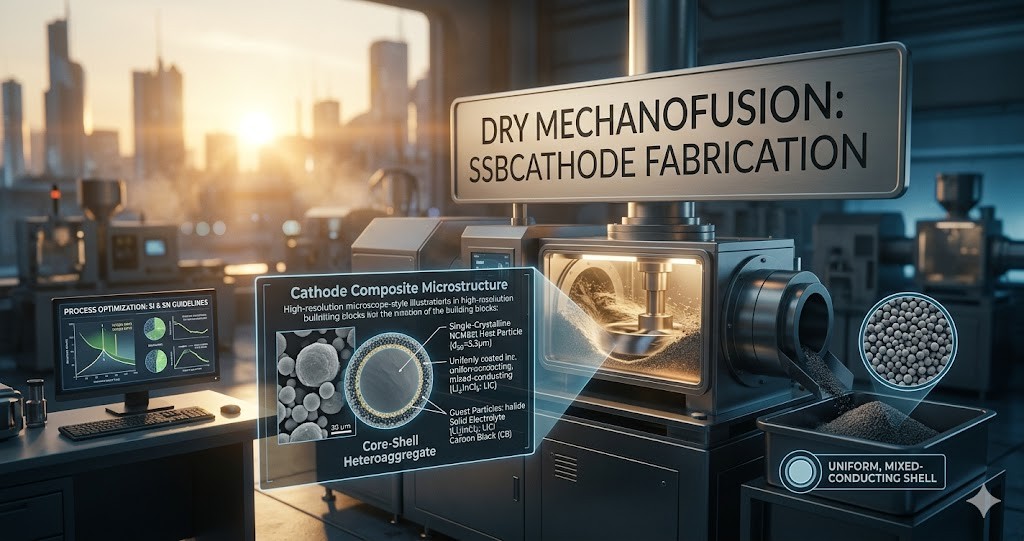
全固体電池の商用化には、高容量アノードに見合う高効率な正極複合体の開発が不可欠です。しかし、正極活物質(CAM)、固体電解質(SE)、導電助剤を最適に配置した「微細構造」を大規模かつ再現性高く製造することは極めて困難でした。
- 従来の課題: 研究室レベルの乳鉢混合(手作業)は再現性がなく、スケーラビリティに欠ける。一方、機械的混合は粒子のランダムな配置に留まり、理想的な界面構築が難しい。
- 解決策の提示: 単結晶NCM821(CAM)をホスト粒子とし、柔軟なハロゲン化物固体電解質(Li3InCl6: LIC)とカーボンブラック(CB)をゲスト粒子とした、メカノフュージョンによる高強度乾式混合プロセス。
1. 混合プロセスの概念:ボトムアップ・ビルディングブロック
本研究では、粒子を単に混ぜるのではなく、機能的な「ビルディングブロック(核・殻構造の粒子集合体)」を設計しています。
- ホスト粒子: 単結晶 NCM821 (d50 = 3.3μm)。多結晶に比べ化学的・機械的安定性が高く、高強度混合に耐えうる。
- ゲスト粒子: LIC(固体電解質)およびCB(導電助剤)。LICの柔軟性を利用し、メカノフュージョンのせん断力でCAM表面に均一な膜を形成。
- 混合装置: スケーラブルな高強度ミキサーを使用。ローターと壁面の狭いギャップで発生する高せん断力を利用。
2. 実験結果:組成と形態の相関
コーティングの厚さと均一性は、SEの含有量とプロセス条件によって制御可能です。
- コーティング形態の変化:
- 薄膜(1 wt.%): 数ナノメートルの均一な被覆。界面保護層として機能。
- 厚膜マトリックス(20 wt.%): 100nm以上の厚みを持ち、マトリックスとして機能。CAM同士の凝集を封じ込め、パッキング密度を向上させる。
- 物理的特性: コーティング量の増加に伴い、粒子の円形度が増し、バルク空隙率(Porosity)が低下(約25%まで減少)。これは、柔らかいLICが隙間を埋めるため。
- 混合導電性マトリックス: LICにCBをあらかじめ混合してコーティングすることで、イオン伝導と電子伝導を同時に担保するシェルを形成。
3. DEM(離散要素法)シミュレーションによるプロセス最適化
「どの程度の強さで、どのくらいの時間混ぜればよいか」という問いに対し、DEMシミュレーションを用いて定量的指針(Stressing conditions)を提示しています。
- ストレス強度 (SI) と ストレス回数 (SN):
- 回転数 (rpm): SI に直結。高回転(10,000 rpm)では、短時間で滑らかかつ均一な被覆(Coverage > 97%)が達成される。
- 混合時間: SN に直結。低回転でも時間をかければ被覆率は上がるが、形態は不均一(粒子状の付着)になりやすい。
- 材料の健全性: SPED(走査歳差電子回折)やXPSによる解析の結果、10,000 rpmという高負荷条件でも単結晶NCMの結晶構造破壊や界面での元素相互拡散は見られず、プロセスとしての安定性が確認された。
4. 電池特性への影響
最適化された混合導電性マトリックス(NCM:LIC:CB = 80:20:x)を用いた正極は、追加処理なしで優れた性能を示しました。
- 放電容量: 1Cレートで 100 mAh/g(複合体全重量ベース)の安定したサイクル特性。
- 組成の最適化: CB含有量を増やすとCAMの利用率は向上するが、過剰なCBはイオン伝導パスの阻害や化学的・機械的な劣化を招く。混合プロセスと組成のバランスが「電池の動力学(Kinetics)」を決定する鍵。
まとめ:技術戦略的インサイト
本論文が示す手法は、全固体電池製造において以下のパラダイムシフトを提案しています。
- 「混ぜる」から「作る」へ: 粒子をランダムに分散させるのではなく、精密に設計された「ビルディングブロック」を中間体として製造することで、大規模生産における品質安定化が可能になる。
- 乾式プロセスの優位性: 溶媒を使用しない乾式コーティングは、環境負荷を抑えつつ、固体電解質の溶媒による損傷リスクを回避できる。
- デジタルツインの活用: DEMシミュレーションにより、異なる装置スケールや新材料(硫化物系など)へのプロセス転換時の指針を迅速に得ることが可能。
正極複合体の微細構造制御は、電池全体のエネルギー密度と寿命を左右する最重要工程の一つです。メカノフュージョンによるマトリックス形成は、その課題を解決する有力なスケーラブル・ソリューションと言えます。
出典:https://www.nature.com/articles/s41467-026-71305-2
Manufacturing Innovation for Mass Production of Next-Generation SSBs: Cathode Composite Fabrication via Dry Mechanofusion
The commercialization of All-Solid-State Batteries (SSBs) necessitates the development of high-efficiency cathode composites that match the performance of high-capacity anodes. However, manufacturing “microstructures” with optimally arranged cathode active materials (CAM), solid electrolytes (SE), and conductive additives—with high scalability and reproducibility—has remained a significant challenge.
- Conventional Challenges: Laboratory-scale hand mortaring lacks reproducibility and scalability. Conversely, conventional mechanical mixing often results in random particle distribution, making the construction of ideal interfaces difficult.
- Proposed Solution: A high-intensity dry mixing process via mechanofusion, utilizing single-crystalline NCM821 as host particles and malleable halide solid electrolytes (Li3InCl6: LIC) and carbon black (CB) as guest particles.
1. Mixing Concept: Bottom-Up Building Blocks
Rather than simply mixing particles, this study designs functional “building blocks” (core-shell heteroaggregates).
- Host Particles: Single-crystalline NCM821 (d50 = 3.3 μm). These offer higher chemical and mechanical stability than polycrystalline materials, allowing them to withstand high-intensity mixing.
- Guest Particles: LIC (SE) and CB (additive). By leveraging the malleability of LIC, the shear forces of mechanofusion create a uniform film on the CAM surface.
- Equipment: A scalable high-intensity mixer that utilizes high shear forces generated within the narrow gap between the rotor and the vessel wall.
2. Experimental Results: Correlation between Composition and Morphology
Coating thickness and uniformity can be controlled by SE content and process parameters.
- Morphological Variations:
- Thin Coatings (1 wt.%): Nanometer-scale uniform coverage acting as an interfacial protective layer.
- Thick Matrix (20 wt.%): Over 100 nm thick, acting as a matrix that encapsulates CAM aggregates and improves packing density.
- Physical Properties: Increasing coating content leads to higher particle circularity and lower bulk porosity (reducing to approximately 25%), as the soft LIC fills interstitial spaces.
- Mixed-Conducting Matrix: Pre-mixing CB with LIC before coating ensures a shell that simultaneously provides ionic and electronic conductivity.
3. Process Optimization via DEM (Discrete Element Method) Simulation
The study provides quantitative guidelines (“stressing conditions”) for intensity and duration through DEM simulations.
- Stress Intensity (SI) and Stress Number (SN):
- Rotational Speed (rpm): Directly linked to SI. High speeds (10,000 rpm) achieve smooth, uniform coverage (> 97%) in a short time.
- Mixing Time: Directly linked to SN. While longer times at low speeds increase coverage, the resulting morphology tends to be non-uniform (particulate adhesion).
- Material Integrity: Analysis via SPED (Scanning Precession Electron Diffraction) and XPS confirmed no structural degradation of NCM or elemental interdiffusion at the interface, even under high-load conditions (10,000 rpm).
4. Impact on Battery Performance
Cathodes using the optimized mixed-conducting matrix (NCM:LIC:CB = 80:20:x) demonstrated excellent performance without additional treatment.
- Discharge Capacity: Stable cycling performance of 100 mAh/g (based on total composite mass) at a 1C rate.
- Compositional Optimization: Increasing CB improves CAM utilization, but excessive amounts hinder ionic paths and lead to chemo-mechanical degradation. The balance between mixing process and composition is the key to cell kinetics.
Conclusion: Strategic Technical Insights
This methodology proposes a paradigm shift in SSB manufacturing:
- From “Mixing” to “Engineering”: Precision-engineered “building blocks” as intermediates enable quality stabilization in large-scale production, rather than relying on random dispersion.
- Advantages of Dry Processing: Solvent-free coating reduces environmental impact and eliminates the risk of SE degradation caused by solvent exposure.
- Digital Twin Implementation: DEM simulations allow for rapid guidance when transitioning to different equipment scales or new materials (e.g., sulfide-based electrolytes).
The microstructural control of cathode composites is a critical process determining the energy density and cycle life of the entire battery. Matrix formation via mechanofusion represents a powerful, scalable solution to these challenges.


コメント