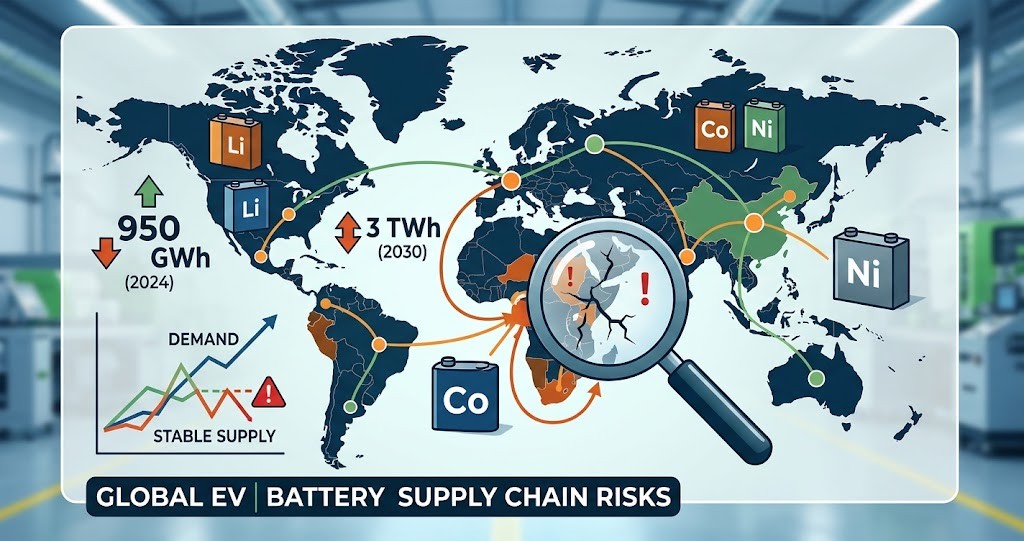
電気自動車(EV)への世界的なシフトが進む中、電池(バッテリー)の確保は自動車・エネルギー業界の最重要課題となっています。世界のEV用バッテリー需要は2024年に950 GWh(ギガワット時)に達し、2030年までに3 TWh(テラワット時)を超えると予測されています。
しかし、この「EV革命」には原料となる重要鉱物(リチウム、コバルト、ニッケル)の供給網(サプライチェーン)に大きなリスクが潜んでいます。iScience誌に掲載された最新の研究(Liu et al., 2026)は、世界の大手電池メーカー9社のサプライネットワークを可視化し、鉱物不足に対する耐性をシミュレーション分析しました。その結果、市場規模の拡大以上にサプライチェーン構造が脆弱であることが明らかになりました。記事の要点と補足情報を以下にまとめています。
ニュースの要約とポイント
1. リチウム不足がもたらす圧倒的な打撃
- 最もリスクが高い元素: リチウム、コバルト、ニッケルの中で、あらゆるシナリオにおいてリチウム不足が最も甚大な損害をもたらすことが判明。コバルトは代替(脱コバルト化)が進み、ニッケルは供給源が多様であるのに対し、リチウムはほぼ全ての電池化学に不可欠であるため。
- BYDやCATLへの甚大な影響: リチウム不足時、BYD主導のネットワークはリン酸鉄リチウム(LFP)の大量生産と垂直統合モデルゆえに最大の損失(シミュレーション値 2587.49)を記録。世界最大手のCATLも、多角的な電池展開と供給源の集中により高い損失を被った。
2. ネットワークの構造的脆弱性と「スーパーハブ」
- 特定企業への集中: サプライチェーンは少数のハブ企業に依存する構造(べき乗則)となっている。商品取引大手グレンコア、リチウム生産のピルバラ・ミネラルズ、素材メーカーのCNGRなどが多数の電池メーカーと連結する「クロスレイヤー・スーパーハブ」を形成。
- 連鎖的リスク: コバルト供給において、グレンコア一社がCATLの損害の73%から92%を占めるなど、単一の供給途絶が下流へ急速に波及する構造が浮き彫りになった。
3. 供給ショックからの回復メカニズム
- 間接的回復が7割以上: 鉱物不足が発生した際、電池メーカーは直接契約する取引先からの回復(10~12%)ではなく、業界内でサプライヤー同士がリソースを再配分する「間接的な回復」(70~74%)に大きく依存している。
- 回復力の指標: 損害の絶対額の大きさと、不足の深刻度に対する感度(回復力反応係数)は必ずしも一致しない。例えばパナソニックは比較的損失が低く安定していたのに対し、サムスンSDIやEVE Energyはニッケル不足に対して高い感度を示した。
補足・関連情報
研究対象となった大手電池メーカー9社
本研究では、世界市場を牽引する以下の9社を中心にネットワークが分析されました。
- 中国: CATL(寧徳時代)、BYD(比亜迪)、CALB(中創新航)、Gotion(国軒高科)、EVE Energy(億緯鋰能)
- 韓国: LG Energy Solution、SK Innovation(SK On)、Samsung SDI
- 日本: パナソニック(Panasonic)
サプライチェーンリスクへの対策と示唆
- 単なる多様化より「ターゲットを絞った対策」: 全体的な調達先の分散よりも、ボトルネックとなる主要ルート(例:特定の正極材メーカーや精製拠点)の二重調達化やバックアップ供給業者の事前認定、在庫バッファーの確保が有効であると指摘されている。
- リサイクルの限界と効果: GEMやUmicoreなどのリサイクルネットワークは、深刻な供給不足下でコバルト損害を約10%、ニッケル損害を約9.7%削減する効果が見られたが、供給経路が変化することで特定のシナリオでは局所的なリスクを高める側面も確認された。
Direct Impact on CATL and BYD — The Truth About the Damage Lithium Shortages Cause to Global Battery Giants
As the global shift to electric vehicles (EVs) progresses, securing batteries has become the top priority for the automotive and energy industries. Global EV battery demand reached 950 GWh (gigawatt-hours) in 2024 and is projected to exceed 3 TWh (terawatt-hours) by 2030.
However, a major risk lies hidden in the supply chain of critical minerals (lithium, cobalt, and nickel) that serve as raw materials for this “EV revolution.” A recent study published in the journal iScience (Liu et al., 2026) mapped the supply networks of nine major global battery manufacturers and simulated their resilience to mineral shortages. The results revealed that the supply chain structure is far more fragile than market scale alone would suggest. The key points of the news and supplementary information are summarized below.
Summary and Key Points of the News
- Overwhelming Damage Caused by Lithium Shortages
- Most At-Risk Element: Among lithium, cobalt, and nickel, lithium shortages were found to inflict the most severe damage across all scenarios. This is because cobalt substitution (cobalt-free chemistry) is progressing and nickel benefits from diverse supply sources, whereas lithium is indispensable to nearly all battery chemistries.
- Massive Impact on BYD and CATL: During a lithium shortage, the network led by BYD recorded the largest loss (simulated value of 2587.49) due to its massive production of lithium iron phosphate (LFP) and its vertically integrated model. CATL, the world’s largest manufacturer, also suffered high losses due to its broad battery portfolio and supplier concentration.
- Structural Vulnerabilities and “Superhubs” in the Network
- Concentration in Specific Companies: Supply chains follow a structure dependent on a small number of hub companies (power-law distribution). Major commodity trader Glencore, lithium producer Pilbara Minerals, and material manufacturer CNGR form “cross-layer superhubs” connected to numerous battery makers.
- Cascading Risks: In cobalt supply, Glencore alone accounted for 73% to 92% of CATL’s damage, highlighting a structure where a single supply disruption rapidly cascades downstream.
- Recovery Mechanisms from Supply Shocks
- Indirect Recovery Accounts for Over 70%: When mineral shortages occur, battery manufacturers rely heavily on “indirect recovery” (70% to 74%), where suppliers reallocate resources among themselves within the industry, rather than direct recovery through their contract suppliers (10% to 12%).
- Metrics of Resilience: The absolute magnitude of loss does not necessarily align with sensitivity to shortage severity (resilience response coefficient). For example, Panasonic had relatively low losses and remained stable, whereas Samsung SDI and EVE Energy showed high sensitivity to nickel shortages.
Supplementary and Related Information
Nine Major Battery Manufacturers Analyzed in the Study The study analyzed network structures centered on the following nine leading companies in the global market:
- China: CATL, BYD, CALB, Gotion, EVE Energy
- South Korea: LG Energy Solution, SK Innovation (SK On), Samsung SDI
- Japan: Panasonic
Implications and Countermeasures for Supply Chain Risk
- Targeted Measures Over Simple Diversification: Rather than general procurement diversification, targeted interventions—such as dual-sourcing for bottleneck routes (e.g., specific cathode manufacturers and refining hubs), pre-qualifying backup suppliers, and securing inventory buffers—are highlighted as more effective.
- Limits and Effects of Recycling: Recycling networks like GEM and Umicore reduced cobalt losses by about 10% and nickel losses by about 9.7% under severe shortages, but altering supply pathways was also found to paradoxically increase localized risks in certain scenarios.
コメント