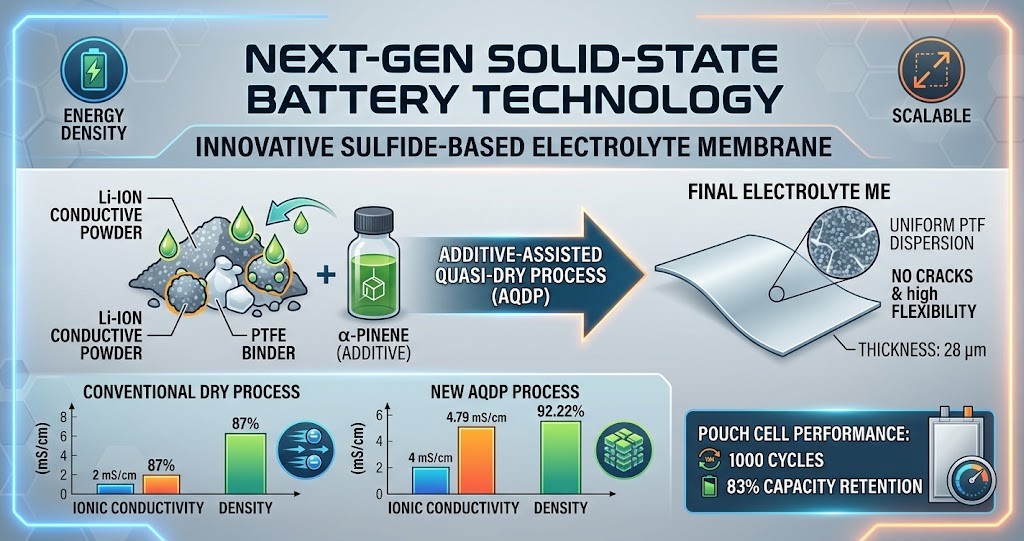
上海交通大学やCATL(寧徳時代新能源科技)などの研究チームが、全固体電池(ASSB)の実用化に向けた革新的な硫化物系固体電解質膜の製造技術を発表しました。全固体電池のエネルギー密度向上と工業規模での量産には、薄膜化、高イオン電導度、大面積化、高密度化を同時に満たす電解質膜が必要ですが、従来のドライプロセス(乾式法)やウェットプロセス(湿式法)ではこれらを高度に両立させることが難題でした。
論文(Nature Communications, 2026年9月10日オンライン掲載)の概要と関連情報を以下にまとめます。
研究の概要
- 新技術(AQDP)の開発: 有機添加剤であるα-ピネン(α-pinene)を活用した「添加剤補助準ドライプロセス(AQDP)」を開発。
- α-ピネンの主な役割:
- 柔軟性の向上: 加圧時のストレスを分散し、ひび割れを抑制して大面積化・薄膜化を実現。
- 電導度の向上: PTFEバインダーの偏りを抑えて均一に分散させ、高いイオン電導性を維持。
- 高密度化(滑剤効果): 潤滑作用により膜の気孔率を12.24パーセントから7.78パーセントへ低減。
- 容易な熱除去: 120度で20分間の加熱処理により、電解質に悪影響を与えずほぼ完全に除去可能。
- 作製した電解質膜(Li5.5PS4.5Cl1.5)のスペック:
- 厚み・サイズ: 厚さ28マイクロメートル、面積30×10平方センチメートルの自立型薄膜。
- イオン電導度: 25度において4.79 mS/cm(元の粉末の85パーセント以上の電導度を維持)。
- 電池セルでの性能検証:
- モールドセル: 2 MPaの圧力下、30度・1 Cにて500サイクル後も93パーセントの容量を維持。
- ポーチセル(実用レベル): 50 mAh級のポーチセルにおいて、2 MPa・40度・0.5 Cで1000サイクル後に83パーセントの容量維持率を達成。
関連情報(背景・補足)
- 全固体電池における「硫化物系」の位置付け:
- 固体電解質には酸化物系、硫化物系、高分子系、ハロゲン化物系などがありますが、硫化物系は室温でのイオン電導度が最も高く(液体電解質と同等レベル)、加圧成型が容易なため、車載用などの高出力・高エネルギー密度電池の本命とされています。
- 従来の製造プロセスの課題とAQDPの優位性:
- ウェットプロセス: 有機溶剤の毒性、回収・乾燥コスト、溶剤と硫化物の化学反応による劣化が課題。
- 従来のドライプロセス: 溶剤コストを抑えられる一方、バインダー(PTFE)による絶縁性悪化や膜の空隙(気孔)が多くなる点が問題でした。
- AQDPの位置付け: ドライプロセスの低コスト・安全性を保ちつつ、微量の低極性添加剤(α-ピネン)を潤滑・分散剤として一時的に使うことで、両者の課題を解決した革新的な手法です。
- 低束縛圧(2 MPa)動作の産業的意義:
- 全固体電池は充放電に伴う膨張・収縮を抑えるため、通常は高い圧力(数十MPa以上)をかけ続ける必要がありますが、本研究では2 MPaという比較的低い拘束圧力で1000サイクルの長寿命動作を確認しており、車載化時のパック構造の軽量化・簡略化に大きく貢献します。
出典:https://www.nature.com/articles/s41467-026-77590-1
Overcoming Conventional Weaknesses: Alpha-Pinene-Assisted Quasi-Dry Process Dramatically Boosts All-Solid-State Battery Performance
A research team including Shanghai Jiao Tong University and CATL (Contemporary Amperex Technology Co., Limited) has announced an innovative fabrication technology for sulfide solid electrolyte films aimed at commercializing all-solid-state batteries (ASSBs). Improving the energy density of ASSBs and enabling industrial-scale mass production require electrolyte films that simultaneously achieve thinness, high ionic conductivity, large-area scalability, and high density; however, achieving all these features at a high level using conventional dry or wet processes has remained a major challenge.
Below is a summary of the research overview and related background information based on the paper published online in Nature Communications on September 10, 2026.
Research Overview
- Development of a New Technology (AQDP): Developed an “additive-assisted quasi-dry process (AQDP)” utilizing alpha-pinene as an organic additive.
- Primary Roles of Alpha-Pinene:
- Improved Flexibility: Suppresses cracking by dissipating stress during pressing, enabling large-area and thin-film fabrication.
- Enhanced Conductivity: Prevents aggregation of the PTFE binder by promoting uniform dispersion, thereby maintaining high ionic conductivity.
- Increased Densification (Lubrication Effect): Reduces film porosity from 12.24 percent to 7.78 percent through a lubrication effect.
- Facile Thermal Removal: Can be almost completely removed via thermal treatment at 120 degrees Celsius for 20 minutes without adversely affecting the electrolyte.
- Specifications of the Fabricated Electrolyte Film (Li5.5PS4.5Cl1.5):
- Thickness and Dimensions: A freestanding thin film with a thickness of 28 micrometers and dimensions of 30 by 10 square centimeters.
- Ionic Conductivity: Achieves 4.79 mS/cm at 25 degrees Celsius, retaining over 85 percent of the pristine powder’s conductivity.
- Performance Verification in Battery Cells:
- Mold Cells: Retained 93 percent capacity after 500 cycles at 1 C under 2 MPa pressure at 30 degrees Celsius.
- Pouch Cells (Practical Level): A 50 mAh pouch cell retained 83 percent capacity after 1,000 cycles at 0.5 C under 2 MPa at 40 degrees Celsius.
Related Information (Background and Context)
- Role of Sulfide Electrolytes in All-Solid-State Batteries: Among solid electrolytes—which include oxides, sulfides, polymers, and halides—sulfide-based electrolytes possess the highest ionic conductivity at room temperature (comparable to liquid electrolytes) and feature good cold-pressability, making them the primary candidate for high-output, high-energy-density automotive applications.
- Challenges of Conventional Processes and Advantages of AQDP:
- Wet Processes: Face challenges such as toxic organic solvents, high recovery/drying costs, and degradation caused by chemical reactions between solvents and sulfides.
- Conventional Dry Processes: While reducing solvent costs, they suffer from degraded ionic conductivity due to insulating binders (PTFE) and higher film porosity.
- Positioning of AQDP: An innovative method that solves the drawbacks of both approaches by temporarily utilizing a small amount of low-polarity additive (alpha-pinene) as a lubricant and dispersant while retaining the low cost and safety of dry processing.
- Industrial Significance of Low Stack Pressure (2 MPa) Operation: All-solid-state batteries typically require high continuous operating pressure (tens of MPa or more) to suppress expansion and contraction during charging and discharging. This study demonstrated long cycle life over 1,000 cycles under a relatively low stack pressure of 2 MPa, which will significantly contribute to reducing weight and simplifying battery pack design for EV applications.


コメント