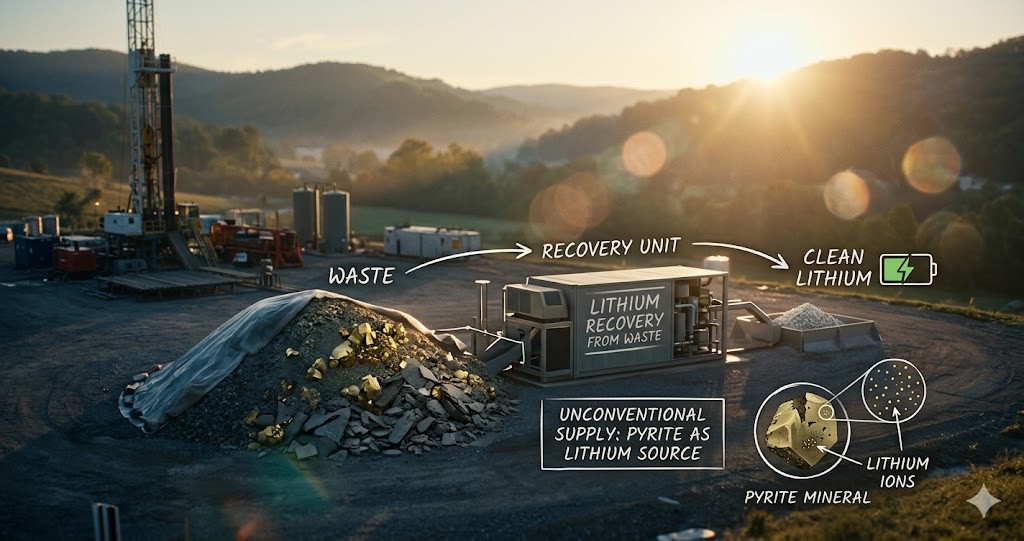
現代のエネルギー転換において、リチウムは「白い石油」とも呼ばれる極めて重要な資源です。従来のリチウム採取は塩湖(ブライン)や硬岩鉱床(ペグマタイト)が主流でしたが、急増する需要に応えるため、未利用の資源や産業廃棄物からリチウムを回収する革新的なアプローチが求められています。ウェストバージニア大学を中心とする研究チームによる今回の発見は、北米アパラチア盆地の石油・ガス採掘に伴う副産物が、リチウムの新たな供給源となる可能性を示唆しています。
1. 研究の背景と目的
リチウム需要の爆発的な増加に伴い、新たな経済的かつ持続可能な供給源の特定が急務となっています。
- 未利用資源の活用: 過去や現在の石油・ガス掘削活動で発生した「掘削屑(カッティングス)」や「鉱山残渣」をリチウム源として利用することは、新たな環境負荷を抑えつつ資源を確保できるため、非常に魅力的です。
- 調査対象: アパラチア盆地(米国)のデボン紀頁岩(シェール)層から採取された、有機物含有量の異なる15個のサンプルを分析しました。
2. 画期的な発見:黄鉄鉱(パイライト)へのリチウム濃縮
従来、頁岩中のリチウムは主に粘土鉱物(ケイ酸塩)に含まれると考えられてきましたが、今回の研究で予想外の結果が得られました。
- 黄鉄鉱からの高い回収率: 岩石全体のリチウム含有量が比較的低いサンプル(22 ppm)であっても、全リチウムの最大54%が黄鉄鉱相から遊離することが判明しました。
- 相関関係: 黄鉄鉱の含有量と、浸出液中のリチウム回収率の間には強い正の相関(r 2 = 0.732)が認められました。
- 新発見の意義: 有機物に富む頁岩において、黄鉄鉱がリチウムの保持体としてこれまで認識されていなかった重要な役割を果たしている可能性が示されました。
3. 推定される地球化学的メカニズム
黄鉄鉱にリチウムが取り込まれるプロセスは完全には解明されていませんが、以下の要因が関与していると推測されています。
- 熱成熟度の影響: 調査対象の頁岩層は熱成熟度が非常に高く、粘土鉱物がスメクタイトからイライトへ変換される過程でリチウムが再移動した可能性があります。
- 温度感受性: リチウムの移動性は温度変化に敏感であり、摂氏75度から135度の範囲では、硫化鉄の相と共存するLi2S(硫化リチウム)として安定化する可能性が指摘されています。
4. 産業および経済的インパクト
この研究結果は、エネルギー業界に新しいビジネスモデルを提示しています。
- 掘削屑の再評価: 既存の石油・ガス井から排出される膨大な量の掘削屑が、リチウム抽出の「原材料」となる可能性があります。
- サプライチェーンの強化: 北米国内に存在する一般的な鉱物である黄鉄鉱からリチウムを抽出できれば、海外依存度の低い安定したリチウム供給網の構築に寄与します。
- 今後の課題: 黄鉄鉱からリチウムを結合させる反応の速度論(キネティクス)や具体的な反応段階の解明が、経済的な抽出プロセスを確立するための鍵となります。
出典:https://meetingorganizer.copernicus.org/EGU24/EGU24-369.html
Drill Cuttings as a Lithium Source? Up to 54% Lithium Liberation from Pyrite in Shale
In today’s energy transition, lithium is an extremely vital resource, often referred to as “white oil.” While traditional lithium extraction has been dominated by brine lakes and hard-rock deposits (pegmatite), the skyrocketing demand necessitates innovative approaches to recover lithium from untapped resources and industrial waste. This discovery by a research team led by West Virginia University suggests that byproducts from oil and gas extraction in the North American Appalachian Basin could serve as a new source of lithium.
1. Research Background and Objectives
With the explosive growth in lithium demand, identifying new economic and sustainable sources has become an urgent priority.
- Utilization of Untapped Resources: Using “drill cuttings” and “mine tailings” generated from past and present oil and gas drilling activities as lithium sources is highly attractive, as it secures resources while minimizing new environmental impacts.
- Study Area: The team analyzed 15 samples with varying organic matter content collected from Devonian shale formations in the Appalachian Basin (USA).
2. Breakthrough Discovery: Lithium Enrichment in Pyrite
Conventionally, lithium in shale was thought to be primarily contained within clay minerals (silicates). However, this study yielded unexpected results.
- High Recovery from Pyrite: Even in samples with relatively low bulk lithium content (22 ppm), it was found that up to 54% of the total lithium could be liberated from the pyrite phase.
- Correlation: A strong positive correlation (r 2 = 0.732) was observed between pyrite content and the lithium recovery rate in the leachate.
- Significance of the Discovery: The findings indicate that in organic-rich shales, pyrite may play a previously unrecognized and significant role as a lithium carrier.
3. Proposed Geochemical Mechanisms
While the process by which lithium is incorporated into pyrite is not yet fully understood, several factors are hypothesized to be involved:
- Effect of Thermal Maturity: The studied shale layers have very high thermal maturity. It is possible that lithium remobilized during the conversion of clay minerals from smectite to illite.
- Temperature Sensitivity: Lithium mobility is highly sensitive to temperature changes. It has been suggested that in the range of 75 to 135 degrees Celsius, lithium may stabilize as Li2S (lithium sulfide) in coexistence with iron sulfide phases.
4. Industrial and Economic Impact
The results of this study present a new business model for the energy industry.
- Revaluation of Drill Cuttings: The vast amount of drill cuttings discharged from existing oil and gas wells could potentially become “raw material” for lithium extraction.
- Strengthening the Supply Chain: Extracting lithium from pyrite—a common mineral found within North America—would contribute to building a stable lithium supply chain with reduced dependence on overseas sources.
- Future Challenges: Understanding the reaction kinetics and specific reaction stages that bind lithium to pyrite is the key to establishing an economically viable extraction process.


コメント