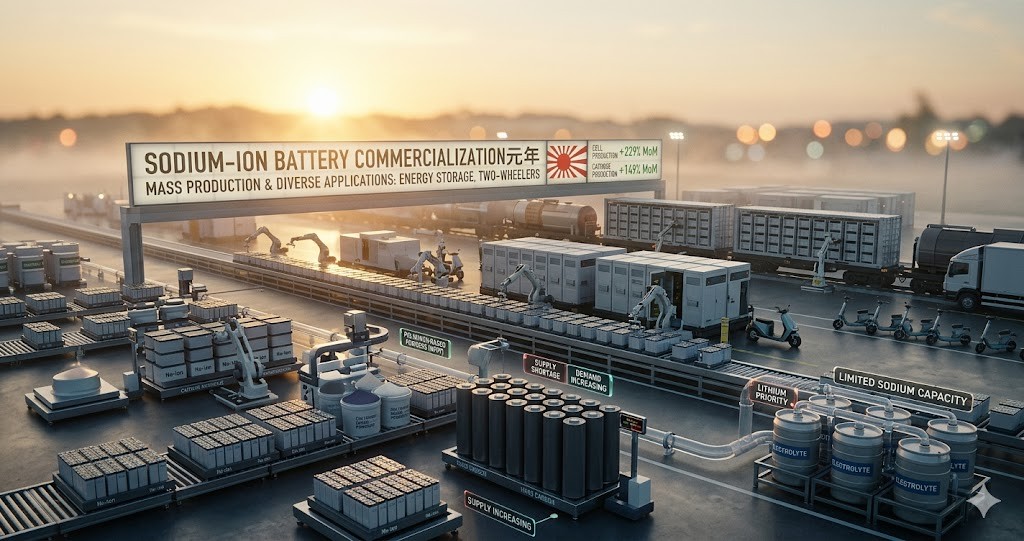
2026年3月、中国のナトリウムイオン電池産業は旧正月(春節)休暇の停滞期を脱し、主要なサプライチェーン全体で爆発的な回復を見せました。エネルギー貯蔵システム(ESS)や電動二輪車市場からの需要が追い風となり、第2四半期以降の本格的な量産拡大に向けた基盤が整いつつあります。
以下に、SMM(上海金属市場)の分析に基づく最新の市場動向をまとめました。
1. 正極材:ポリアニオン系が主流を維持しつつ構造が多様化
3月の正極材生産量は前月比149%増(149% increase MoM)、前年同月比110%増(110% increase YoY)と驚異的な伸びを記録しました。
- 材料構成の変化: ポリアニオン系(主にNFPP)が依然として市場の77%を占める主流ですが、層状酸化物系の需要もスタートストップ電源や電動二輪車向けに急回復しています。
- 企業の動向: 大手リチウム電池メーカーがナトリウムイオン電池専用ラインの試運転やサンプルテストを加速させており、4月には生産量が前月比さらに8%増加する見込みです。
2. 硬質炭素(ハードカーボン)負極:供給不足が続く成長のボトルネック
負極材も前月比82%増と大幅に回復しましたが、依然として需要が供給を上回る状態が続いています。
- 高い性能要求: 電池セルメーカーは、サイクル寿命や初期効率の向上を求めており、サプライヤーの選定と検証を急いでいます。
- 今後の見通し: 4月は生産計画がさらに20%加速する見通しですが、供給不足の解消には下半期までの新規生産能力の稼働を待つ必要があります。
3. 電解液:リチウム向け優先による制約
電解液の生産量は前月比91%増となりましたが、材料セグメントの中では伸びが緩やかです。
- リチウム電池優先: メーカーが既存のリチウムイオン電池向け供給を優先しているため、ナトリウムイオン電池向けの生産枠の確保が課題となっています。
- 価格の安定: 生産能力の解放が限定的であることや原材料コストの支えもあり、価格は横ばいで推移しています。
4. 電池セル:爆発的な生産拡大
電池セルの生産量は前月比229%増(229% increase MoM)と、産業チェーンの中で最も顕著な成長を見せました。
- GWクラスの投資: 2026年は多くの企業がGWh(ギガワット時)規模の量産を計画しており、産業の相乗効果が実り始めています。
- 新規用途の拡大: 政策主導のハイブリッド蓄電プロジェクトや、大手メーカーによるスマートナトリウムイオン二輪車の発売が需要を牽引しています。
5. 第2・第3四半期の展望:商用化の「元年」へ
2026年第2四半期(4月-6月)は、材料の供給不足が徐々に解消され、コストパフォーマンスがさらに向上する重要な時期となります。
- ピークシーズンの到来: 4月からは本格的な需要期に入り、エネルギー貯蔵や小型商用車などの分野で大規模な導入が予想されます。
- 市場の確立: 第3四半期(7月-9月)には生産能力が最大限に解放され、エネルギー貯蔵と二輪車を主軸とした多様なアプリケーション環境が整う見通しです。
まとめ
3月の力強い回復により、2026年はナトリウムイオン電池の「大規模商用化の初年度」としての地位を固めつつあります。特に中国国内では、資源リスクの低いナトリウム技術をリチウムに次ぐ「第2の柱」として確立する動きが加速しています。
関連情報:ハードカーボン負極の重要性 ナトリウムイオンはリチウムイオンよりもサイズが大きいため、従来のリチウム電池で使用されるグラファイト(黒鉛)の層間に入り込むことが困難です。そのため、層構造が不規則で隙間の大きい「ハードカーボン」が不可欠な材料となっており、この供給安定性が産業全体の鍵を握っています。
- 1. 正極材:ポリアニオン系が主流を維持しつつ構造が多様化
- 2. 硬質炭素(ハードカーボン)負極:供給不足が続く成長のボトルネック
- 3. 電解液:リチウム向け優先による制約
- 4. 電池セル:爆発的な生産拡大
- 5. 第2・第3四半期の展望:商用化の「元年」へ
- まとめ
- 2026: The “First Year of Commercialization” — Production Volumes Double Across the Sodium Battery Value Chain
- 1. Cathode Materials: Polyanions Remain Mainstream Amid Structural Diversification
- 2. Hard Carbon Anodes: Supply Shortages Remain a Growth Bottleneck
- 3. Electrolytes: Constraints Due to Lithium-ion Priority
- 4. Battery Cells: Explosive Growth in Production
- 5. Outlook for Q2 and Q3: Transition to the “First Year of Commercialization”
- Summary
2026: The “First Year of Commercialization” — Production Volumes Double Across the Sodium Battery Value Chain
In March 2026, China’s Sodium-ion battery industry emerged from the Lunar New Year holiday lull, showing an explosive recovery across the entire supply chain. Driven by strong demand from Energy Storage Systems (ESS) and the electric two-wheeler market, the foundation is being laid for full-scale mass production starting in the second quarter.
The following is a summary of the latest market trends based on analysis from SMM (Shanghai Metals Market).
1. Cathode Materials: Polyanions Remain Mainstream Amid Structural Diversification
Cathode material production in March recorded staggering growth, with a 149% increase MoM and a 110% increase YoY.
- Shifts in Material Composition: Polyanion-based systems (primarily NFPP) remain the dominant choice with a 77% market share. However, demand for layered oxides has also recovered sharply for use in start-stop power supplies and electric two-wheelers.
- Corporate Activity: Major Lithium-ion battery manufacturers are accelerating pilot runs and sample testing on dedicated Sodium-ion lines. Production is expected to rise by an additional 8% in April.
2. Hard Carbon Anodes: Supply Shortages Remain a Growth Bottleneck
While anode production recovered with an 82% MoM increase, demand continues to outpace supply.
- High Performance Requirements: Cell manufacturers are urgently selecting and verifying suppliers, demanding higher standards for cycle life and initial coulombic efficiency.
- Outlook: Production plans are expected to accelerate by another 20% in April, but the supply-demand gap is unlikely to close until new capacities come online in the second half of the year.
3. Electrolytes: Constraints Due to Lithium-ion Priority
Electrolyte production grew by 91% MoM, though this represents a more moderate pace compared to other segments.
- Lithium-ion Priority: Manufacturers continue to prioritize existing Lithium-ion battery supply chains, making it a challenge to secure dedicated production slots for Sodium-ion electrolytes.
- Price Stability: Limited capacity release and steady raw material costs have kept prices flat.
4. Battery Cells: Explosive Growth in Production
Battery cell production saw the most significant growth in the industry chain, surging by 229% MoM.
- GW-scale Investments: In 2026, many companies are planning mass production on a GWh (Gigawatt-hour) scale, signaling that industrial synergies are beginning to bear fruit.
- Expanding New Applications: Demand is being driven by policy-led hybrid energy storage projects and the launch of smart Sodium-ion two-wheelers by major manufacturers.
5. Outlook for Q2 and Q3: Transition to the “First Year of Commercialization”
The second quarter of 2026 (April–June) will be a critical period as material shortages gradually ease and cost-performance continues to improve.
- Arrival of Peak Season: April marks the start of the peak demand season, with large-scale deployments expected in energy storage and small commercial vehicles.
- Market Establishment: By the third quarter (July–September), production capacity is expected to be fully unleashed, creating a diverse application environment centered on ESS and two-wheelers.
Summary
With the robust recovery in March, 2026 is solidifying its position as the “First Year of Large-scale Commercialization” for Sodium-ion batteries. Especially within China, there is an accelerating movement to establish Sodium technology—which carries lower resource risks—as a “second pillar” alongside Lithium.
Related Information: The Importance of Hard Carbon Anodes Because Sodium ions are larger than Lithium ions, it is difficult for them to intercalate between the layers of graphite used in conventional Lithium batteries. Consequently, “Hard Carbon”—which has an irregular layer structure with larger gaps—has become an indispensable material. The stable supply of this carbon is the key to the success of the entire industry.

コメント