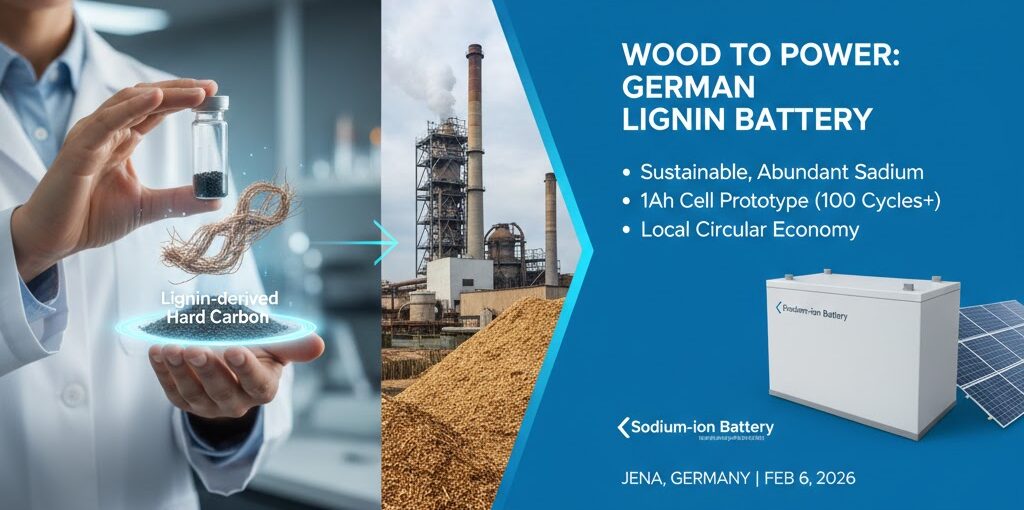
リチウムやコバルトといった希少金属への依存が、現代のバッテリー産業における大きな課題となっています。こうした中、ドイツの研究チームが発表した「リグニン(木材の主成分)」をベースにしたナトリウムイオン電池のプロトタイプは、次世代の持続可能なエネルギー貯蔵技術として大きな注目を集めています。木材パルプ産業の副産物を利用し、安価で安定した供給が可能なこの技術は、エネルギー自立と環境負荷低減を同時に実現する可能性を秘めています。
1. 技術の核心:リグニン由来の「ハードカーボン」
今回の研究の鍵となるのは、植物の細胞壁に含まれる有機ポリマーリグニンです。
- 原材料の背景: 木材・パルプ産業で大量に発生する副産物であり、現在はその多くが燃料として燃焼処分されています。
- 変換プロセス: 研究チームは、マーサー・ローゼンタール社から供給されたリグニンを不活性条件下で熱分解(炭化)し、「ハードカーボン(難黒鉛化性炭素)」を生成しました。
- 特性: このハードカーボンは層状構造が不規則で隙間が多く、リチウムイオンよりもサイズの大きいナトリウムイオンを可逆的に出し入れ(貯蔵・放出)するのに極めて適した構造を持っています。
2. 実証実験の結果と将来の目標
フラウンホーファーIKTSとイエナ大学、および地域企業が連携し、1Ah(アンペアアワー)のセルプロトタイプで実証実験を行いました。
| 項目 | 詳細・成果 |
| 開発主体 | フラウンホーファーIKTS、フリードリヒ・シラー大学イエナ、他産業諮問委員会 |
| 試作セル容量 | 1 Ah (アンペアアワー) |
| 耐久性実績 | 100回の充放電サイクルで顕著な劣化なし |
| 今後の目標 | プロジェクト終了までに200サイクルの実証 |
| 主な用途 | 据置型蓄電池(再生可能エネルギー貯蔵)、移動型蓄電デバイス |
3. ナトリウムイオン電池が注目される理由(関連情報)
リチウムイオン電池(LIB)と比較した場合のメリットは以下の通りです。
- 資源の豊富さ: ナトリウムは食塩の主成分であり、地球上にほぼ無限に存在します。リチウムのように特定の地域からの調達に依存(地政学的リスク)する必要がありません。
- コストの低減: 原材料が安価であることに加え、負極の集電体に高価な銅箔ではなく、より安価なアルミニウム箔を使用できるため、製造コストを大幅に抑えられます。
- 安全性: 熱暴走のリスクがリチウムイオン電池に比べて低く、輸送時の安全性も高いとされています。
まとめ:地域産業と連携した「循環型」モデル
このプロジェクトの大きな特徴は、ドイツ・テューリンゲン州を拠点とする企業(Mercer Rosenthal社やEAS Batteries社など)を中心とした産業諮問委員会の強力なバックアップを受けている点です。
地元の未利用資源(リグニン)をハイテク産業の素材へ転換し、地域内でバッテリーを製造・利用するこのモデルは、「資源の自立」と「サーキュラーエコノミー(循環型経済)」の理想的な形を示しています。今後はサイクル寿命のさらなる向上と、量産化に向けた技術詳細の確立が期待されます。
Value from Waste: The Potential of Sustainable Sodium-Ion Batteries Powered by Lignin
Dependence on critical raw materials like lithium and cobalt remains a significant challenge for the modern battery industry. In this context, a German research team has unveiled a sodium-ion battery prototype based on lignin—a primary component of wood—drawing significant attention as a next-generation sustainable energy storage technology. By utilizing a byproduct of the wood pulp industry, this technology offers a low-cost, stable supply chain and holds the potential to achieve both energy independence and a reduced environmental footprint.
1. The Core Technology: Lignin-Derived “Hard Carbon”
The key to this research is lignin, a complex organic polymer found in the cell walls of plants.
- Raw Material Background: A byproduct generated in massive quantities by the wood and pulp industry, lignin is currently mostly incinerated for fuel.
- Conversion Process: The research team took lignin supplied by Mercer Rosenthal and carbonized it through pyrolysis under inert conditions to produce “hard carbon” (non-graphitizable carbon).
- Properties: This hard carbon has an irregular, disordered layered structure with numerous gaps. This makes it exceptionally well-suited for the reversible storage and release of sodium ions, which are larger in size than lithium ions.
2. Experimental Results and Future Goals
Fraunhofer IKTS, Friedrich Schiller University Jena, and various regional partners collaborated to conduct tests on a 1 Ah (Ampere-hour) cell prototype.
| Item | Details & Achievements |
| Developers | Fraunhofer IKTS, Friedrich Schiller University Jena, and Industrial Advisory Board |
| Prototype Capacity | 1 Ah |
| Durability Record | No significant degradation after 100 charge/discharge cycles |
| Future Goal | Demonstrate 200 cycles by the end of the project |
| Primary Applications | Stationary storage (Renewable energy), Mobile storage devices |
3. Why Sodium-Ion Batteries are Gaining Attention
The advantages compared to lithium-ion batteries (LIBs) include:
- Abundant Resources: Sodium is a primary component of common salt and is virtually inexhaustible. It eliminates the need to rely on specific regions for sourcing (reducing geopolitical risks) associated with lithium.
- Lower Costs: In addition to cheap raw materials, sodium-ion batteries can use aluminum foil for the negative electrode current collector instead of expensive copper foil, significantly driving down manufacturing costs.
- Safety: They offer a lower risk of thermal runaway compared to LIBs and are considered safer during transport.
Summary: A “Circular” Model Linked with Regional Industry
A standout feature of this project is the strong backing from an industrial advisory board consisting of companies based in Thuringia, Germany (such as Mercer Rosenthal, EAS Batteries, etc.).
By transforming local, underutilized resources into high-tech materials and manufacturing batteries within the region, this model represents an ideal form of resource independence and the circular economy. Moving forward, the focus will remain on further improving cycle life and establishing technical details for mass production.
コメント