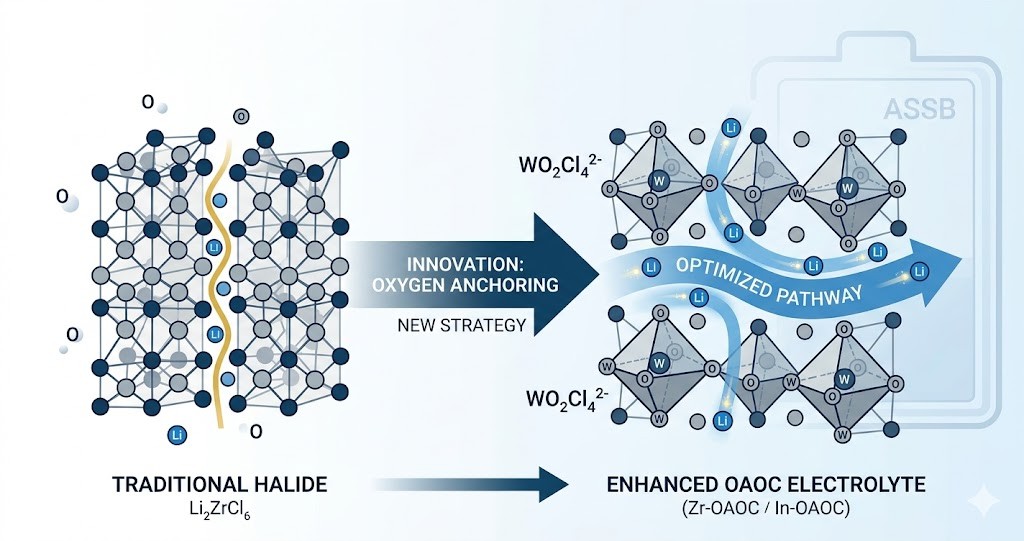
本研究は、次世代のエネルギー貯蔵デバイスである全固体電池(ASSB)において、ハロゲン化物固体電解質の性能を極限まで引き出すための新しい設計指針を提示したものです。
1. 固体電解質の分類と具体的な化学式
現在、研究されている主な固体電解質と、本研究で開発された新材料の立ち位置は以下の通りです。
- 従来のハロゲン化物(ホスト材料)
- Li2ZrCl6(塩化リチウムジルコニウム)
- Li3InCl6(塩化リチウムインジウム)
- Li3YCl6(塩化リチウムイットリウム)
- 高い酸化安定性と延性を持ちますが、密な格子構造がイオン移動を制限していました。
- 本研究で開発された酸素結合型オキシ塩化物(OAOC)
- Li2Zr0.94W0.06Cl5.88O0.12(Zr-OAOC)
- Li2.98In0.98}W0.02Cl5.96O0.04(In-OAOC)
- これらは、ホストの格子内に WO2Cl2(オキシ塩化タングステン)を精密に組み込んだ新しい化合物です。
- 比較対象となる既存材料
- 硫化物系:Li6PS5Cl(リチウムアルジロダイト型。本研究の電池試験でも使用)
- 酸化物系:Li7La3Zr2O12(LLZO)
2. 核心技術:酸素アンカーによる格子制御
研究チームは、高電荷を持つタングステンW6+が酸素と強力に結びつく性質を利用し、格子の秩序を保ったまま酸素を導入する手法を確立しました。
[構造変化のメカニズム]
- 多面体ユニットの形成: 酸素はバラバラに存在するのではなく、WO2Cl42- という安定した多面体ユニットとして格子に固定(アンカー)されます。
- リチウム(Li)サイトの多様化: 導入された酸素の影響で、Liイオンが収まる場所が従来の「八面体」から、移動に適した「四面体」へと変化します。
- 移動エネルギーの平坦化: Liイオンと周囲のアニオン(Cl, O)との相互作用が弱まり、イオンが格子内をスムーズに移動できるようになります。
3. 実証された成果:伝導性と安定性の両立
この戦略を適用した結果、複数のハロゲン化物系で顕著な性能向上が確認されました。
| 評価項目 | 改善の成果 |
| イオン伝導率 | Li2ZrCl6 では 30°C で 1.12 mS cm-1 に到達(未処理の約3倍)。 |
| 空気安定性 | 加水分解が抑制され、湿度 50% の環境でも構造の完全性を維持。 |
| 電池性能 | NCM622 正極を用いた全固体電池で、高いレート特性と 100サイクル後 80% 以上の容量維持を実証。 |
4. 結論
本研究は、WO2Cl2 を用いた酸素導入が、特定の材料だけでなく多様なハロゲン化物(Zr, In, Y, Erベース)に適用できる「普遍的な戦略」であることを明らかにしました。
この「酸素固定化」という設計理念は、既存の材料開発の限界を打ち破るものであり、高出力かつ安全な次世代全固体電池の実用化を大きく前進させるものと期待されます。
今回の材料設計のポイントは、単に混ぜるのではなく、格子レベルで酸素を固定してイオンの通り道をデザインした点にあります。
出典:https://advanced.onlinelibrary.wiley.com/doi/10.1002/aenm.202506744
Universal Oxychlorination Strategy for Halide Solid Electrolytes in All-Solid-State Batteries
This study presents a new design principle to maximize the performance of halide solid electrolytes for All-Solid-State Batteries (ASSBs), the next generation of energy storage devices.
1. Classification of Solid Electrolytes and Specific Chemical Formulas
The following describes the primary solid electrolytes currently under research and the positioning of the new materials developed in this study.
- Conventional Halides (Host Materials)
- Li2ZrCl6 (Lithium zirconium chloride)
- Li3InCl6 (Lithium indium chloride)
- Li3YCl6 (Lithium yttrium chloride)
- These possess high oxidative stability and ductility, but their dense lattice structures have historically limited ionic mobility.
- Oxygen-Anchored OxyChlorides (OAOC) Developed in This Study
- Li2Zr0.94W0.06Cl5.88O0.12 (Zr-OAOC)
- Li2.98In0.98W0.02Cl5.96O0.04 (In-OAOC)
- These are novel compounds created by precisely integrating WO2Cl2 (tungsten oxychloride) into the host lattice.
- Existing Materials for Comparison
- Sulfide-based: Li6PS5Cl (Argyrodite-type; also used in this study’s battery tests)
- Oxide-based: Li7La3Zr2O12 (LLZO)
2. Core Technology: Lattice Control via Oxygen Anchoring
The research team established a method to introduce oxygen while maintaining lattice order by utilizing the property of high-valent tungsten ($W^{6+}$) to bond strongly with oxygen.
[Mechanism of Structural Change]
- Formation of Polyhedral Units: Oxygen does not exist sporadically; instead, it is fixed (anchored) within the lattice as stable [WO2Cl4]2− polyhedral units.
- Diversification of Lithium (Li) Sites: The introduced oxygen causes the Li-ion occupancy sites to shift from conventional “octahedral” sites to “tetrahedral” sites, which are more conducive to mobility.
- Flattening of Migration Energy: Interactions between Li ions and surrounding anions (Cl, O) are weakened, allowing ions to move more smoothly through the lattice.
3. Demonstrated Results: Balancing Conductivity and Stability
Applying this strategy resulted in significant performance improvements across multiple halide systems.
| Evaluation Item | Improvement Results |
| Ionic Conductivity | Li2ZrCl6 reached 1.12 mS cm-1 at 30°C (approx. 3x higher than untreated). |
| Air Stability | Hydrolysis is suppressed, maintaining structural integrity even in 50% humidity. |
| Battery Performance | Demonstrated high rate capability and >80% capacity retention after 100 cycles in ASSBs using NCM622 cathodes. |
4. Conclusion
This study reveals that oxygen introduction using WO2Cl2 is a “universal strategy” applicable to a wide range of halides (based on Zr, In, Y, and Er), not just specific materials.
The design philosophy of “oxygen anchoring” breaks through the limitations of existing material development and is expected to significantly advance the commercialization of high-power, safe, next-generation all-solid-state batteries. The key to this material design lies in designing the ionic pathways by anchoring oxygen at the lattice level, rather than simply mixing components.


コメント