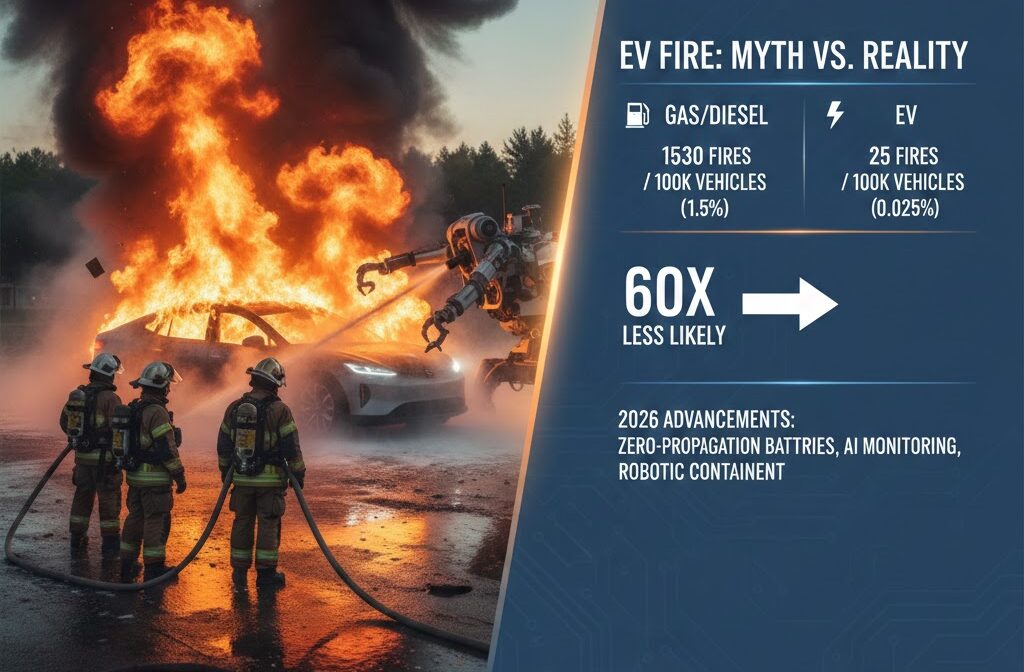
電気自動車(EV)の普及に伴い、メディアを騒がせる「バッテリー火災」。一度火がつけば1000℃を超える猛烈な熱を発し、数日間も燃え続けるその姿は、まさに現代の悪夢と言えるかもしれません。しかし、その恐怖の裏には、統計が示す意外な事実と、命懸けで立ち向かう消防現場の苦悩が隠されています。
1. なぜ「消火」ではなく「隔離」なのか?:熱暴走の恐怖
リチウムイオン電池が火災を起こすと、通常のガソリン車とは全く異なる「熱暴走(サーマルランナウェイ)」という現象が発生します。
- 自己持続する炎: バッテリー内部で化学反応が連鎖し、酸素を自ら生成しながら燃え続けるため、窒素などで空気を遮断しても火は消えません。
- 水のジレンマ: 水は冷却に有効ですが、バッテリーケースが頑丈で内部まで届きにくく、さらに電気伝導性があるため新たな短絡(ショート)を招くリスクもあります。
- 有毒ガスの発生: 燃焼時にはフッ化水素などの極めて有害なガスが発生し、周囲数百メートルの住民に避難を強いることもあります。
- 再燃のリスク: 表面の火が消えたように見えても、内部のエネルギーが残っていれば数時間、時には数日後に突然再燃することがあります。
このため、現在の消防プロトコルでは「無理に消火して水を無駄にする(数万リットル必要)」よりも、延焼を防ぐための「隔離」と「監視」が優先されるケースが増えています。
2. 数字が語る「EV火災」の意外な希少性
ショッキングな映像が拡散されやすいEV火災ですが、統計データを見ると、ガソリン車(ICE)よりも圧倒的に発生率は低いのが現実です。
| 車両タイプ | 10万台あたりの火災件数 | 火災発生率 |
| ガソリン・ディーゼル車 | 約 1,530 件 | 約 1.5% |
| ハイブリッド車 (HEV) | 約 3,475 件 | 約 3.5% |
| 電気自動車 (EV) | 約 25 件 | 約 0.025% |
- メディアの歪み: EV火災は珍しく、かつ消火が困難でドラマチックなため大きく報じられますが、実際にはガソリン車の方が約60倍も火災リスクが高いという調査結果(米NTSB等)が出ています。
- ノルウェーの事例: EV普及率が極めて高いノルウェーでは、車両火災全体に占めるEVの割合はわずか7%程度にとどまっています。
3. 進化する安全対策と消防技術(2026年最新動向)
「解決困難」とされたEV火災に対し、技術革新と法規制が急速に進んでいます。
- 車載用「ヒューズ」素材: LG化学などが開発した、温度上昇を感知して電流を物理的に遮断する新しい熱暴走抑制材料が実用化されつつあります。
- 強化される規制: 2026年からは、一つのセルで熱暴走が起きても他のセルへ伝播させない「ゼロ・プロパゲーション(延焼ゼロ)」基準が主要国で義務化され始めています。
- 消防ロボットの導入: 車体下部から直接バッテリーへ注水したり、車両を持ち上げて隔離場所へ運ぶ専用ロボットの導入が世界各地の消防署で進んでいます。
まとめ:正しく恐れ、進化を見守る
EVの火災は、確かに発生すれば「消防士の悪夢」となるほど厄介なものです。しかし、それはエンジニアが克服すべき「技術的課題」であり、日常的に発生する「一般的な危険」ではありません。
統計的にはガソリン車よりも安全であり、さらに監視システム(BMS)の高度化によって、予兆を検知して事前に警告を出す機能も標準化されています。私たちはショッキングな見出しに惑わされることなく、技術がこの「悪夢」をどう飼い慣らしていくのかを見極める必要があります。
出典:https://www.gadgetreview.com/1832f-nightmare-why-firefighters-are-giving-up-on-extinguishing-evs
Destructive but Rare: The Truth Behind the “EVs are Dangerous” Misconception
As electric vehicles (EVs) go mainstream, “battery fires” have become a media sensation. With temperatures exceeding $1,000^\circ\text{C}$ ($1,832^\circ\text{F}$) and flames that can last for days, an EV fire is a modern nightmare. However, behind the terrifying headlines lie surprising statistical facts and the strategic struggles of firefighters facing these high-stakes incidents.
1. Why “Isolate” Rather Than “Extinguish”? The Fear of Thermal Runaway
When a lithium-ion battery catches fire, it triggers a phenomenon known as “Thermal Runaway,” which is fundamentally different from a gasoline car fire.
- Self-Sustaining Flames: The chemical reaction within the battery occurs in a chain, generating its own oxygen. This means the fire cannot be smothered by traditional methods like nitrogen or foam.
- The Water Dilemma: While water is effective for cooling, battery casings are often so rugged that water cannot reach the internal cells. Furthermore, because water conducts electricity, it poses a risk of causing additional short circuits.
- Toxic Gas Emission: Combustion releases extremely hazardous gases, such as hydrogen fluoride, which may necessitate the evacuation of residents within several hundred meters.
- Risk of Reignition: Even if the surface fire appears extinguished, stored internal energy can cause the battery to suddenly reignite hours—or even days—later.
Consequently, current firefighting protocols often prioritize “isolation and monitoring” to prevent the spread of fire, rather than wasting tens of thousands of liters of water on a futile immediate extinguishment.
2. The Statistical Reality: The Surprising Rarity of EV Fires
While shocking videos of EV fires go viral, statistical data reveals that their occurrence rate is significantly lower than that of Internal Combustion Engine (ICE) vehicles.
| Vehicle Type | Fire Incidents per 100k Sales | Incident Rate |
| Gasoline/Diesel (ICE) | Approx. 1,530 | ~1.5% |
| Hybrid (HEV) | Approx. 3,475 | ~3.5% |
| Electric (EV) | Approx. 25 | ~0.025% |
- Media Bias: EV fires are rare, dramatic, and difficult to extinguish, making them prime news targets. However, research (e.g., from the U.S. NTSB) shows that gasoline cars are roughly 60 times more likely to catch fire than EVs.
- The Norway Example: In Norway, where EV adoption is the highest in the world, EVs account for only about 7% of all vehicle fires.
3. Advancing Safety Measures and Firefighting Tech (2026 Trends)
Technology and regulations are rapidly evolving to address the “unsolvable” challenge of EV fires.
- On-board “Fuse” Materials: New thermal runaway suppression materials, such as those developed by LG Chem, are being implemented. These materials physically block electrical current upon sensing a temperature spike.
- Stricter Regulations: Starting in 2026, many major markets are mandating “Zero-Propagation” standards, ensuring that even if one cell fails, the fire does not spread to neighboring cells.
- Firefighting Robotics: Specialized robots that can inject water directly into the battery pack from beneath the chassis or tow vehicles to submerged isolation tanks are being deployed at fire stations globally.
Summary: Fear Based on Facts, Not Hype
An EV fire is undoubtedly a “firefighter’s nightmare” once it starts. However, it should be viewed as a “technical engineering challenge” to be solved, rather than a “common daily hazard.”
Statistically, EVs are safer than gasoline vehicles. With the advancement of Battery Management Systems (BMS) that can detect early warning signs and alert drivers before an incident occurs, we are moving toward a future where this nightmare is fully contained by engineering excellence.

コメント